Auto Provision IP Phones in Local Network (PnP Method)
This topic describes how to auto provision IP phones that are located in the same local network as Yeastar P-Series PBX System.
Supported IP phones
This topic can be applied to all the IP phones listed in Auto Provisioning - Supported Devices.
Prerequisites
- The IP Phone and PBX must be in the same LAN subnet.
- Example: Same LAN subnet
IP: 192.168.5.150, Mask: 255.255.255.0
IP: 192.168.5.170, Mask: 255.255.255.0
- Example: Different LAN subnet
IP: 192.168.5.150, Mask: 255.255.255.0
IP: 192.168.66.170, Mask: 255.255.255.0
- Example: Same LAN subnet
- IP Phone MUST support PnP provisioning method.
- Make sure that you have downloaded the template for the desired phone model on the PBX (Path: ).
Scenario
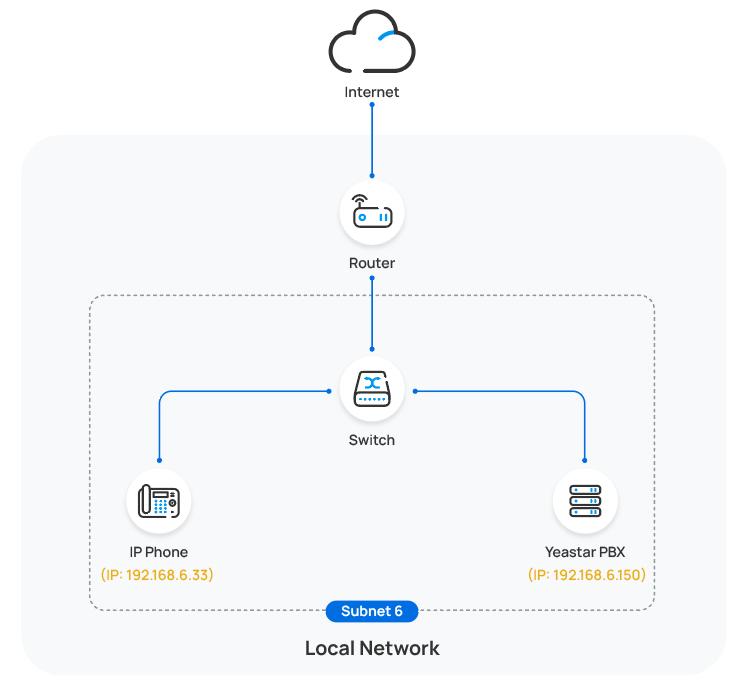
An IP phone (IP: 192.168.6.33) and the PBX (IP: 192.168.6.150) are deployed in the same LAN subnet 6.
Procedure
- Power on the PBX first, then power on the IP phones.
- RESET the IP phone if it is previously used.
- Log in to PBX web portal, go to .
The phone list displays all the discovered IP phones with their related information including model, MAC address, IP address, etc.
Note:- Only the supported devices can be discovered and displayed on the phone provisioning list.
- Restart the phones if they are not discovered and displayed on the phone provisioning list.
- Click
 beside the desired phone.
 - In the Options section, configure the following
settings:
- Template: Select a desired template from the
drop-down list.Note: The template provides configurations except extension assignment. You can select the default template corresponding to the phone model, or customize your own template.
For more information, see Create a Custom Auto Provisioning Template.
- Provisioning Method: Select PnP
(In the Office).
A provisioning server URL is generated automatically and displayed on the web page.
- Template: Select a desired template from the
drop-down list.
- In the Assign Extension
section, assign extension(s) to the phone, then specify which extension's
phonebook and function keys you want to use on the phone.Note:
- This feature is available only for non-DECT IP phones that are not set as hot desking phones.
- If your desired extension is not listed in the drop-down list of
the Extension column, it indicates that
the devices registered to the extension has reached the limit.
You can use either of the following methods to proceed.
- To release the previous phone or gateway, see Release an Extension from a Provisioned IP Phone/Gateway.
- To raise the phone registration limit, see Allow Multiple Registrations for One Extension Number.
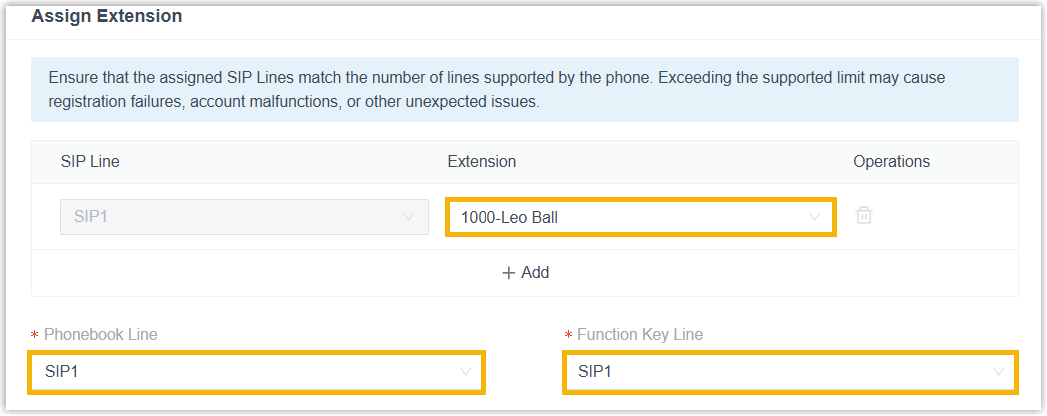
- To assign a single extension, select the desired extension from the
drop-down list beside SIP1.
Both the Phonebook Line and the Function Key Line are set to SIP1 by default, indicating that the phone will use the authorized phonebook(s) and function keys of the extension assigned to the SIP line 1.
- To assign multiple extensions, complete the following
settings.
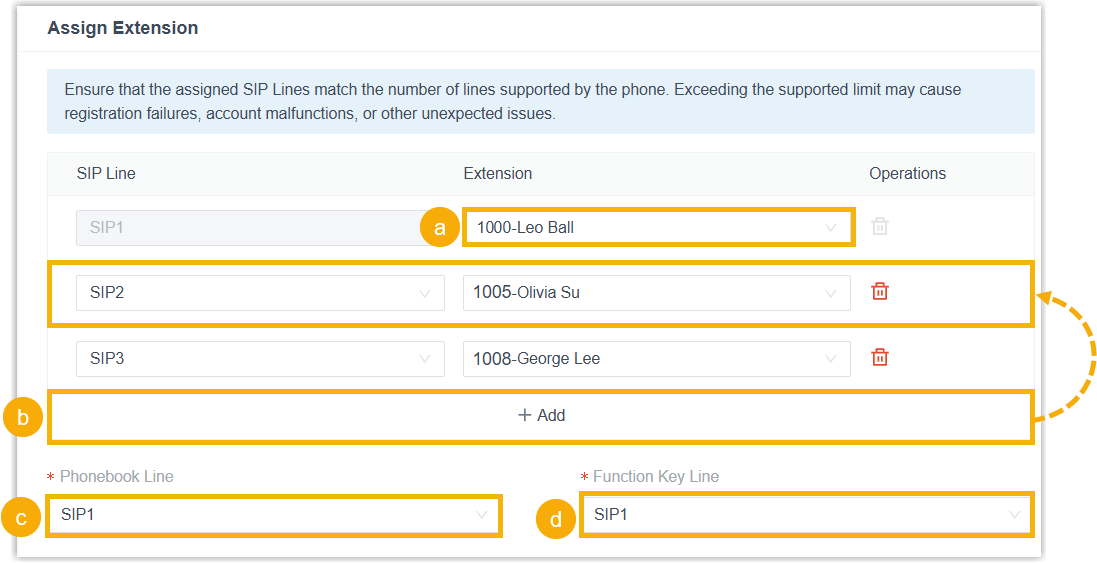
- In the drop-down list beside SIP1, select a desired extension for SIP line 1.
- Click Add, then select a desired SIP
line and an extension for the added entry.To assign more extensions to the phone, repeat this step.Note: The selected SIP lines must be supported by the phone, otherwise the configurations for unsupported SIP line will not be applied. You can check the phone's supported SIP lines via the phone webpage or on the device screen.
- In the Phonebook Line drop-down list,
select a SIP line. The phonebook of extension assigned to
the SIP line will be applied to the phone.Note: After successful registration, contacts are available regardless of which SIP line is currently active on the phone.
- In the Function Key Line drop-down
list, select a SIP line. The function keys of extension
assigned to the SIP line will be applied to the phone.Note: After successful registration, the function keys take effect only when the selected SIP line is active on the phone. For more information about configuring function keys for the phone, see Auto Provision Function Keys for Phones.
- Click Save.
Result
- The configurations will be automatically applied to the phone.
- The extension registration status of provisioned phones is displayed on .Tip: You can also check the extension registration status directly via the phone webpage or on the device screen.
 : All assigned extensions are registered on the
phone.
: All assigned extensions are registered on the
phone. : Only some of the assigned extensions
are registered on the phone.Note: You can hover over to view the registration
status of each extension.
: Only some of the assigned extensions
are registered on the phone.Note: You can hover over to view the registration
status of each extension.
 : None of the assigned extensions are
registered on the phone.
: None of the assigned extensions are
registered on the phone.

- If multiple extensions are successfully
registered on the phone, corresponding SIP lines are associated with different
physical line keys on the device.
You can press a line key to activate the target SIP line. The corresponding indicator LED illuminates, and all calls are processed over this SIP line.