Provision Flat-Phone with Yeastar P-Series Cloud Edition
This topic takes Flat-phone B10 (firmware: 15.66.7.12.234) as an example to introduce how to provision Flat-phone with Yeastar P-Series Cloud Edition.
Requirements
The firmwares of Flat-phone and Yeastar PBX meet the following requirements.
| Model | Phone Requirement | PBX Requirement |
|---|---|---|
| B6 | 15.63.11.12.234 or later | 84.19.0.110 or later |
| B10 | 15.66.7.12.234 or later | 84.19.0.110 or later |
| C10 | 15.60.11.12.234 or later | 84.19.0.110 or later |
Prerequisites
- Prepare a DHCP server to provide IP address for the IP phone.Note: Make sure that there is only one DHCP server in the subnet where the IP phones are deployed, or the IP phones may fail to obtain IP addresses.
- Make sure that you have downloaded the template for the desired phone model (Path: ).
- RESET the IP phone if it is previously used.
- Gather information of the IP phone, including Vendor, Model, and MAC address.
Procedure
Step 1. Add the Flat-phone on PBX
Add the IP phone on PBX. The PBX will generate a configuration file based on the
phone's MAC address.
- Log in to PBX web portal, go to .
- Click .
- In the IP Phone section, configure phone information
as follows:
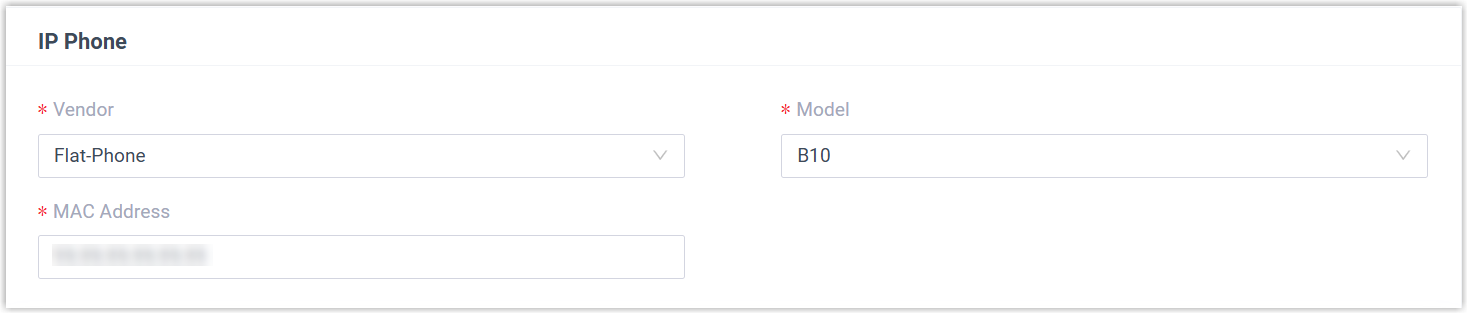
- Vendor: Select Flat-Phone.
- Model: Select a phone model. In this example, select B10.
- MAC Address: Enter the MAC address of the IP phone.
- In the Options section, configure the following
settings.

- Template: Select a desired template from the
drop-down list.Note: You can select the default template corresponding to the phone model, or customize your own template. For more information, see Create a Custom Auto Provisioning Template.
- Provisioning Link: A provisioning link is
automatically generated, which points to the location where the
phone's configuration file is stored.Note: Note down the provisioning link, as you will use it later.
- Template: Select a desired template from the
drop-down list.
- In the Assign Extension section, assign an extension
to the IP phone.
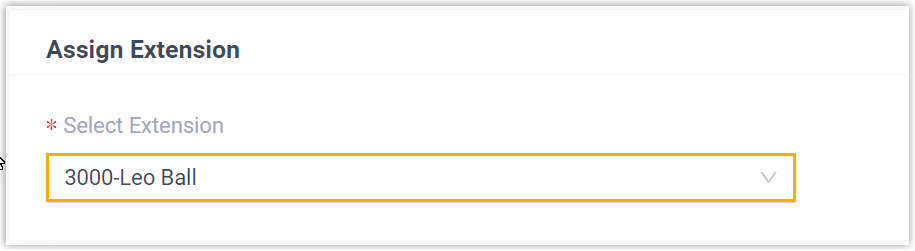 Tip: If your desired extension is not listed in the drop-down list, it indicates that the extension has been associated with an IP phone.
- To release the extension from the associated IP phone, see Release an Extension from a Provisioned IP Phone.
- To register the extension to the phone without releasing it from the previously associated one, you need to configure the concurrent registration setting for the extension, as the PBX only allows an extension to register with one SIP endpoint by default.
- Click Save.
Step 2. Configure DHCP option 66 on DHCP server
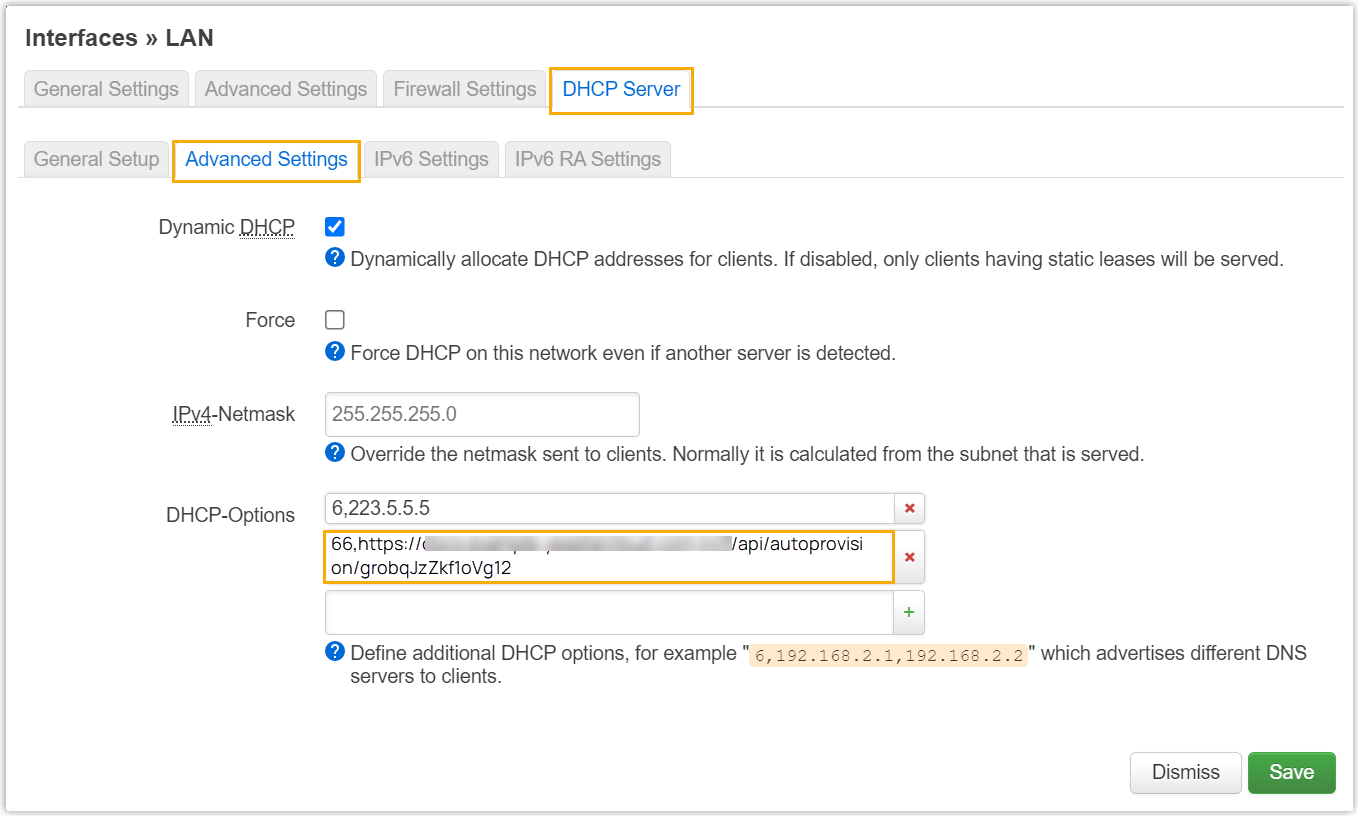
In the subnet where the IP phone is deployed, use the generated provisioning link to configure option 66 on the DHCP Server.
- On PBX web portal, copy the provisioning link from the phone's detail
page.

- On the DHCP server, set up option 66 with the
provisioning
link.
In this example, the configuration is shown below:
Result
Note: Some IP phones will reboot automatically. If not, you need
to manually reboot the phone to make the configurations take effect.
- After the IP phone is rebooted, it gets an IP address from the DHCP server, downloads the configurations from the PBX via the provisioning link, and applies the settings automatically.
- The extension is successfully registered on the IP phone. You can check the
registration status on on the PBX web portal.
 Note: If the status displays
 , this indicates that you assigned
multiple extensions to the IP phone but only some of them are
successfully registered on the phone. You can hover the mouse
over to check registered
details.
, this indicates that you assigned
multiple extensions to the IP phone but only some of them are
successfully registered on the phone. You can hover the mouse
over to check registered
details.
- If multiple extensions are
successfully registered on the phone, corresponding SIP lines are
associated with different physical line keys on the device.
You can press a line key to activate the target SIP line. The corresponding indicator LED illuminates, and all calls are processed over this SIP line.