System Preferences
This topic describes the preference settings that will be applied globally to Yeastar P-Series Cloud Edition.
Go to to configure preferences settings.
Basic preferences
| Setting | Description |
|---|---|
| Device Name | Set a name for the PBX. The name will be used as the sender name when PBX sends emails out. |
| Name Display Format | Set display format for extension user's name and contact's
name.
|
| Max Call Duration (s) | Set the global maximum call duration for an active call. When
the call duration reaches the limit, the call will be ended. The
default value is 10800. Note: For outbound calls, the Max Call Duration
(s) setting of the caller's extension
takes precedence.
|
| Tone Region | Select your country or the nearest neighboring country to enable the default dial tone, busy tone, and ring tone. |
Organization Management
| Setting | Description |
|---|---|
| Organization Management | If enabled, you can arrange extension users into organizations. |
| Company Name | Set your company name, which will be used as the root organization name. |
Read Receipt
| Setting | Description |
|---|---|
| Message Read Receipt | If enabled, in external chats conducted via online messaging
channels (WhatsApp, Facebook, and Live
Chat), both agents and customers can see a read status
indicator ( ) beside their messages, indicating
whether the message has been read by the other party. ) beside their messages, indicating
whether the message has been read by the other party.Note:
|
Caller ID Name
- Caller ID Name Display Rules
-
Setting Description Web Client, Desktop Client, Extension Endpoint Set the display rule for Caller ID Name on Linkus Web Client, Linkus Desktop Client, and extension endpoints (e.g. IP phones and softphones). Note: The display rule currently applies only to the incoming call screen and the call interface.- Display both the contact name and
the caller ID name carried by the
callerNote: If distinctive call feature name or DID/DDI name is enabled, the distinctive name will appear between the matched contact name and the caller ID name.
- Only display the contact name
- Only display the caller ID name
carried by the caller. If the caller only send a
number, the system will display the matched
contact name instead.Note: If distinctive call feature name or DID/DDI name is enabled, the distinctive name will appear in front of the matched contact name or the caller ID name.
Mobile Client Set the display rule for Caller ID Name on Linkus Mobile Client. - Display both the local contact name and the name carried in the From header of the SIP message.
- Only display local contact name
- Only display the name carried in the From header of the SIP message. If it is a number, the system will display the local contact name instead.
Note: To apply the setting to Linkus Mobile Client, extension users must update Linkus app to the following versions:- Linkus iOS Client: Version 5.21.3 or later
- Linkus Android Client: Version 5.21.7 or later
- Display both the contact name and
the caller ID name carried by the
caller
- Distinctive Caller ID Name
-
Setting Description Display Call Feature Name If enabled, the Caller ID will display the originated name when users receive a call from a ring group, queue, IVR, or call flow. Display DID/DDI Name If enabled, the Caller ID will display the DID name of the source trunk. Display the Diversion SIP Header for Extension Forwarding If enabled, when an incoming call to an extension is directly forwarded to the destination type configured for Extension Forwarding with Diversion SIP Header, the Caller ID will display the name and number of the extension from which the call was forwarded.Note: This information can be displayed on both SIP endpoints and Linkus clients. For proper display on Linkus clients, extension users must upgrade their Linkus clients to the following versions:- Linkus Desktop Client: Version 1.22.4 or later
- Linkus Mobile Client:
- Linkus iOS Client: Version 5.25.15 or later
- Linkus Android Client: Version 5.25.14 or later
Masked Number
Specify the scenario(s) where external number will be masked. Once enabled, the number displayed in the call window and call logs will be masked.
- The masking rule applies when receiving and making calls using IP phones, softphones, or Linkus UC Clients. However, when using analog phones, the external numbers will not be masked.
- If the external number is shorter than 6 digits, it will not be masked.
- Callback to a masked number is not allowed.
| Setting | Description |
|---|---|
| Calls initiated via "Open API" | If enabled, destination number will be masked when a third-party application initiates external calls through the API interface. |
| Calls initiated via "Speed Dial" | If enabled, destination number will be masked when extension users make external calls through Speed Dial. |
| Calls initiated via "Click to Call" | If enabled, when extension users initiate calls via
click-to-call using 'Yeastar Linkus for Google' Chrome
extension, destination number will be masked. Note: The version of the Chrome extension
must be 4.11.1 or later. |
| Incoming Calls | If enabled, external numbers will be masked when extension users receiving inbound calls. |
Call Notes
Specify the call scenarios where call notes can be used to add tags and remarks to calls.
| Settings | Description |
|---|---|
| Calls from Queue | If enabled, queue agents can access the call note feature to add tags and remarks during queue calls or in the wrap-up time, and review or edit the call notes later in the corresponding call logs. |
| Calls from Ring Group | If enabled, ring group members can access the call note feature to add tags and remarks during ring group calls, and review or edit the call notes later in the corresponding call logs. |
| Calls to Voicemail | If enabled, extension users can access the call note feature
to add tags and remarks to the calls that were sent to their
extension's voicemails in the corresponding call log. Note: For calls sent to group voicemails,
only administrators can add and edit call notes for the
corresponding calls in the call detail
records
(CDR). |
| Calls to Extensions | If enabled, extension users can access the call note feature to add tags and remarks during the calls they receive, and review or edit the call notes later in the corresponding call logs. |
| Outbound Calls | If enabled, extension users can access the call note feature to add tags and remarks during outbound calls they initiate, and review or edit the call notes later in the corresponding call logs. |
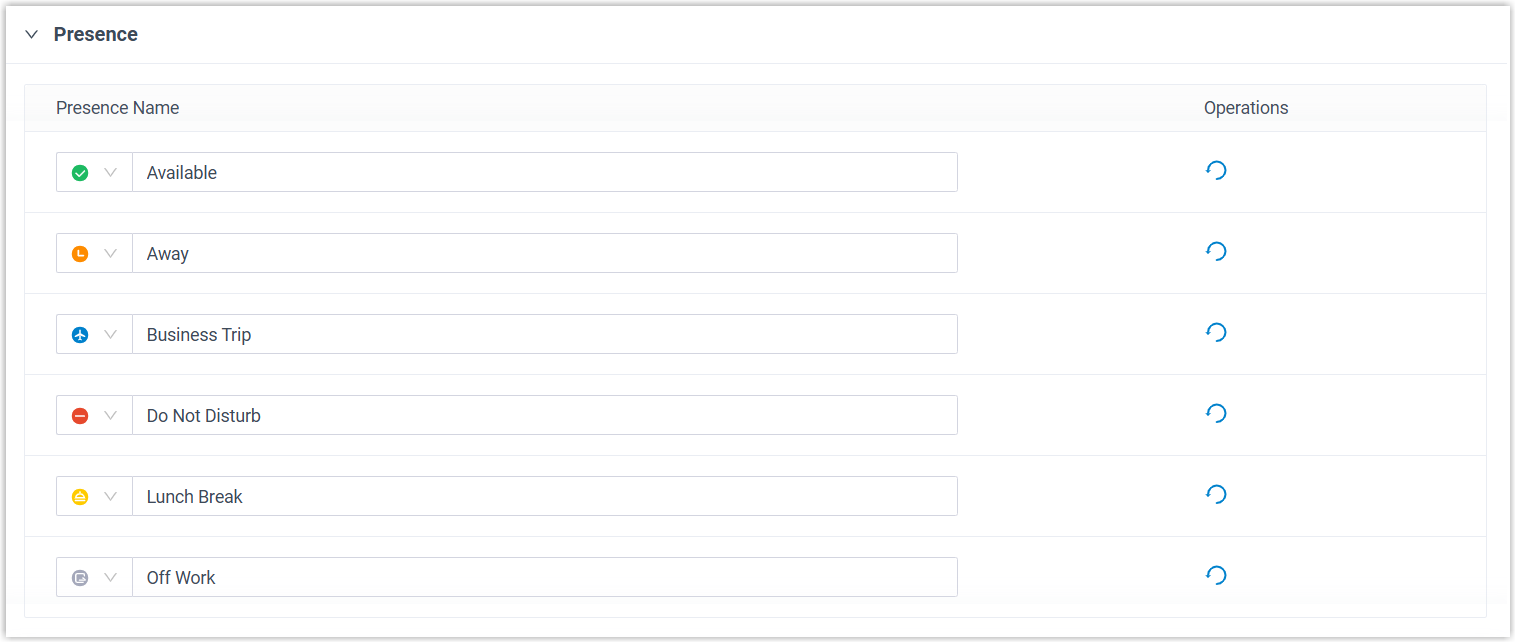
Presence
Customize presence status to indicate extension users' availability. The presence setting will be synchronized across Linkus UC Clients with the following versions:
- Linkus iOS Client: Version 5.15.8 or later
- Linkus Android Client: Version 5.15.4 or later
- Linkus Windows Desktop: Version 1.13.3 or later
- Links Mac Desktop: Version 1.13.3 or later
Filter Number
When this option is enabled, the system will automatically remove all special
characters (except digits, +, *, and
#) from the dialed number before sending it to the trunk.
- If the outbound route used for the call has number adaptation configured, filtering is applied after the number is adapted.
- This setting affects call rate matching, but does not affect emergency calling prefix.
DTMF
| Setting | Description |
|---|---|
| DTMF Passthrough | If enabled, PBX will pass DTMF tones directly to the other end without processing the DTMF tones. |
| DTMF Duration (ms) | Set the duration (in millisecond) of DTMF audio signal sent by the PBX. The default value is 120. |
| DTMF Gap (ms) | Set the interval (in millisecond) between two DTMF audio signals sent by the PBX. The default value is 120. |
Extension Preferences
- PBX treats the followings as extensions. Extension users can dial extension numbers to reach them directly.
- The maximum character length of each user extension is 11, while other extension types are limited to 7 characters.
| Extension Type | Default Range |
|---|---|
| User Extension | 1000 - 5999 |
| Parking Extension | 6000 - 6099 |
| Group Voicemail Extension | 6100 - 6199 |
| IVR Extension | 6200 - 6299 |
| Ring Group Extension | 6300 - 6399 |
| Queue Extension | 6400 - 6499 |
| Conference Extension | 6500 - 6599 |
| Paging Extension | 6600 - 6699 |
| Account Trunk | 6700 - 6799 |
| WebRTC Trunk Number | 6800 - 6899 |
| Call Flow | 6900 - 6999 |
| AI Receptionist | 7000 - 7099 |