Auto Provision Fanvil DECT System with Yeastar P-Series PBX System
A DECT system consists of two parts, DECT base station and DECT handsets (namely DECT phones). This topic describes how to provision the Fanvil DECT base station with Yeastar P-Series PBX System, so that the Fanvil DECT handsets can be connected to the PBX via the base station, allowing users to utilize the handsets as PBX extensions to make and receive calls.
Requirements
| Base Station | Version Requirement | PBX Requirement | Supported Auto Provisioning Method |
|---|---|---|---|
| W710D | 1.18.11 or later |
37.14.0.26 or later |
|
| W710H | 1.0.14.5 or later |
37.14.0.26 or later |
|
The device model and firmware version of the Fanvil DECT system used in this example are shown in the table below.
| Device Model | Firmware Version |
|---|---|
| Fanvil DECT base station | |
| W710D | v1.18.11 |
| Fanvil DECT handset | |
| W610D | v1.16.2 |
Scenarios
The provisioning method and operations vary depending on the network environment of Fanvil DECT system and Yeastar PBX, as the following table shows.
| Scenario | Description |
|---|---|
| DECT system and PBX are in the SAME subnet (LAN) | In this scenario, you can provision the Fanvil DECT system
with Yeastar PBX via PnP method. For more information, see Auto provision Fanvil DECT system in the same subnet (PnP). |
| DECT system and PBX are in DIFFERENT subnets (LAN) | In this scenario, you can provision the Fanvil DECT system
with Yeastar PBX via DHCP method. For more information, see Auto provision Fanvil DECT system in different subnets (DHCP). |
| DECT system and PBX are in DIFFERENT networks | In this scenario, you can provision the Fanvil DECT system
with Yeastar PBX via RPS method. For more information, see Auto provision Fanvil DECT system in remote network (RPS). |
Auto provision Fanvil DECT system in the same subnet (PnP)
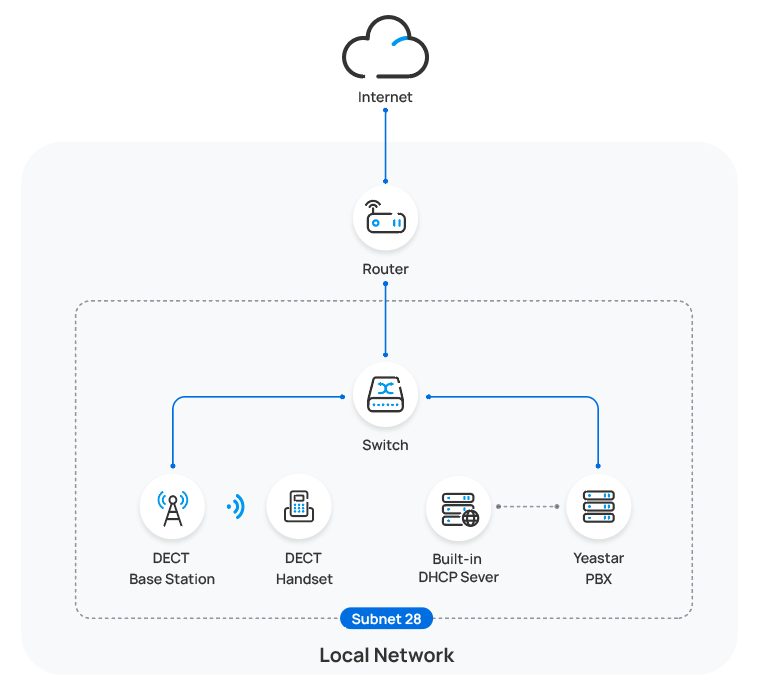
In this example, the Fanvil DECT system (base station and handset) and the Yeastar
PBX (IP: 192.168.28.39) are on the same subnet
(192.168.28.0/24), with the Fanvil DECT base station’s IP
address assigned by a DHCP server.
- Prerequisites
-
- Make sure that there is only one DHCP server running in the subnet, or the DECT base station would fail to obtain an IP address.
- Make sure that the Fanvil DECT system (base station and handset) and Yeastar PBX are on the same subnet.
- Download and install the Fanvil Device Manager (an IP scanning tool) on your computer that is on the same subnet as the Fanvil DECT system.
- Make sure that you have downloaded the template for the desired phone model (Path: ).
- Procedure
- Step 1. Obtain the IP address of the Fanvil DECT base station
- On the DECT base station, use the device button to reset
the device, so that the base station can obtain an IP address from a DHCP
server in the subnet.
- Press and hold the Reset Key on the DECT base
station for at least 10 seconds until all three LEDs start flashing
rapidly, then release the button.
The DECT base station is reset, and it takes several minutes for the device to boot up. After booted up, the three LEDs are solidly lit, indicating that the DECT base station gets an IP address from the DHCP server.
-
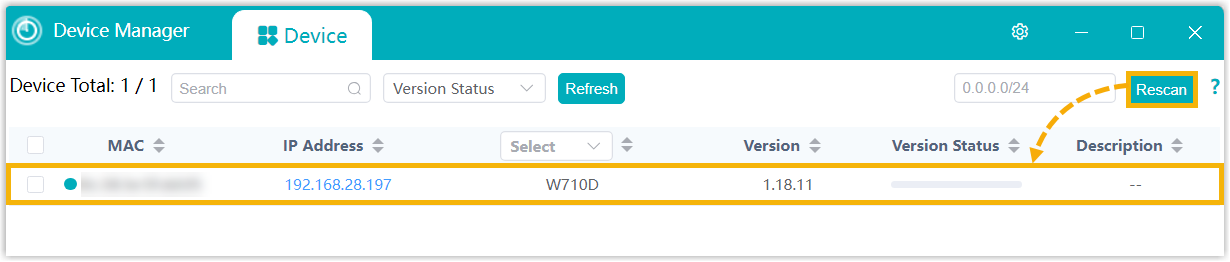
Open the Fanvil Device Manager (an IP scanning tool) and click Rescan.
The DECT base station appears in the Device list along with its IP address.
- Press and hold the Reset Key on the DECT base
station for at least 10 seconds until all three LEDs start flashing
rapidly, then release the button.
- Step 2. Configure the Fanvil DECT base station on PBX
- On PBX web portal, configure the provisioning settings for the DECT base
station, and assign extensions to the DECT handsets.
- Log in to PBX web portal, go to .
The DECT base station detected by the PBX via PnP is displayed in the phone list.
- Click
 to edit the DECT base station.
- In the Assign Extension
section, assign extensions for the DECT handsets according to your
needs.
- To assign extensions one by one, do as follows:
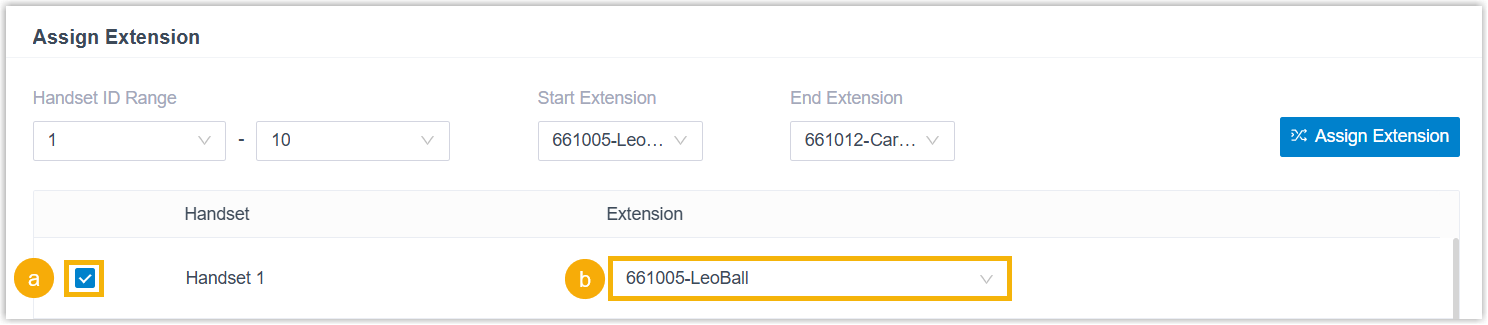
- Select the checkbox of the desired handset.
- In the Extension drop-down list, select the desired extension.
- To assign extensions in bulk, do as follows:
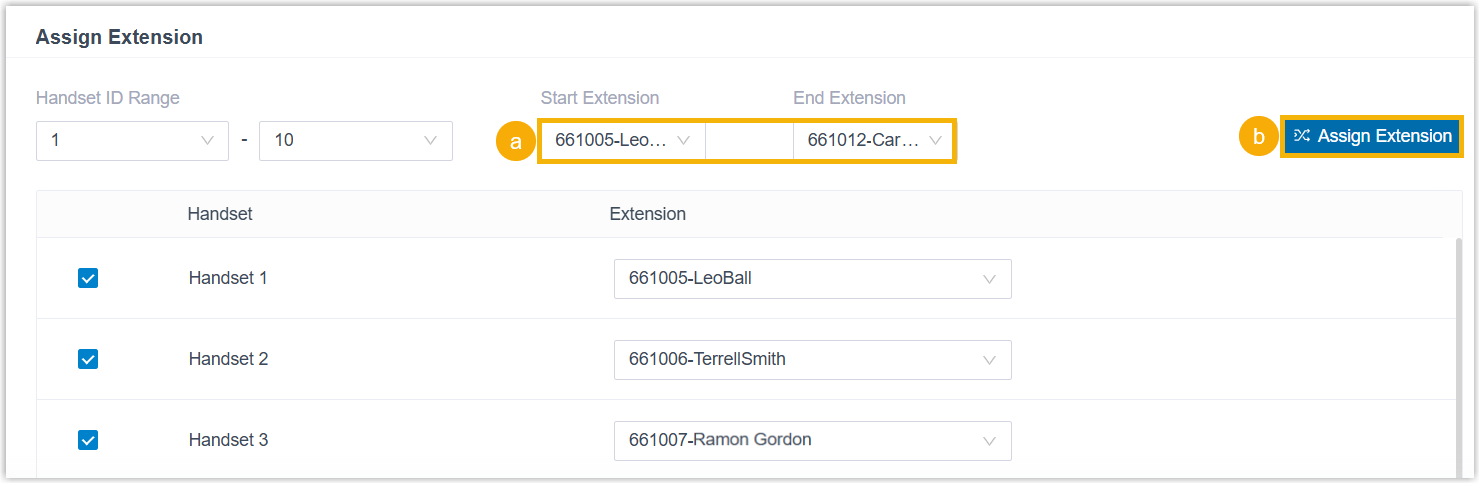
- In the Start Extension and End Extension drop-down lists, set the extension range.
- Click Assign
Extension.
Handsets are automatically enabled and assigned with the specified extensions in sequence.
Tip: If your desired extension is not listed in the drop-down list of the Extension column, it indicates that the devices registered to the extension has reached the limit. You can use either of the following methods to proceed.- To release the extension from the associated IP phone or gateway, see Release an Extension from a Provisioned IP Phone/Gateway.
- To raise the phone registration limit, you need to configure the concurrent registration setting for the extension, as the PBX only allows an extension to register with one SIP endpoint by default.
- To assign extensions one by one, do as follows:
-
Optional: Configure other settings according to your needs.
- Click Save.
- In the phone list, click
 beside the Fanvil DECT base
station to reprovision the device.
beside the Fanvil DECT base
station to reprovision the device. The DECT base station automatically downloads the configurations from the PBX and applies the settings.Tip: You can click
 in front of the DECT base
station to see the extensions assigned to the DECT
handsets.
in front of the DECT base
station to see the extensions assigned to the DECT
handsets.
- Log in to PBX web portal, go to .
- Step 3. Pair the Fanvil DECT handset with the DECT base station
-
Enable the registration mode of the DECT base station, then pair the Fanvil DECT handset with it.
- On the web interface of the DECT base station, enable the
registration mode of the base station.
- Access the web interface of the DECT base station using its
IP address.Note: The default username and password are both
admin.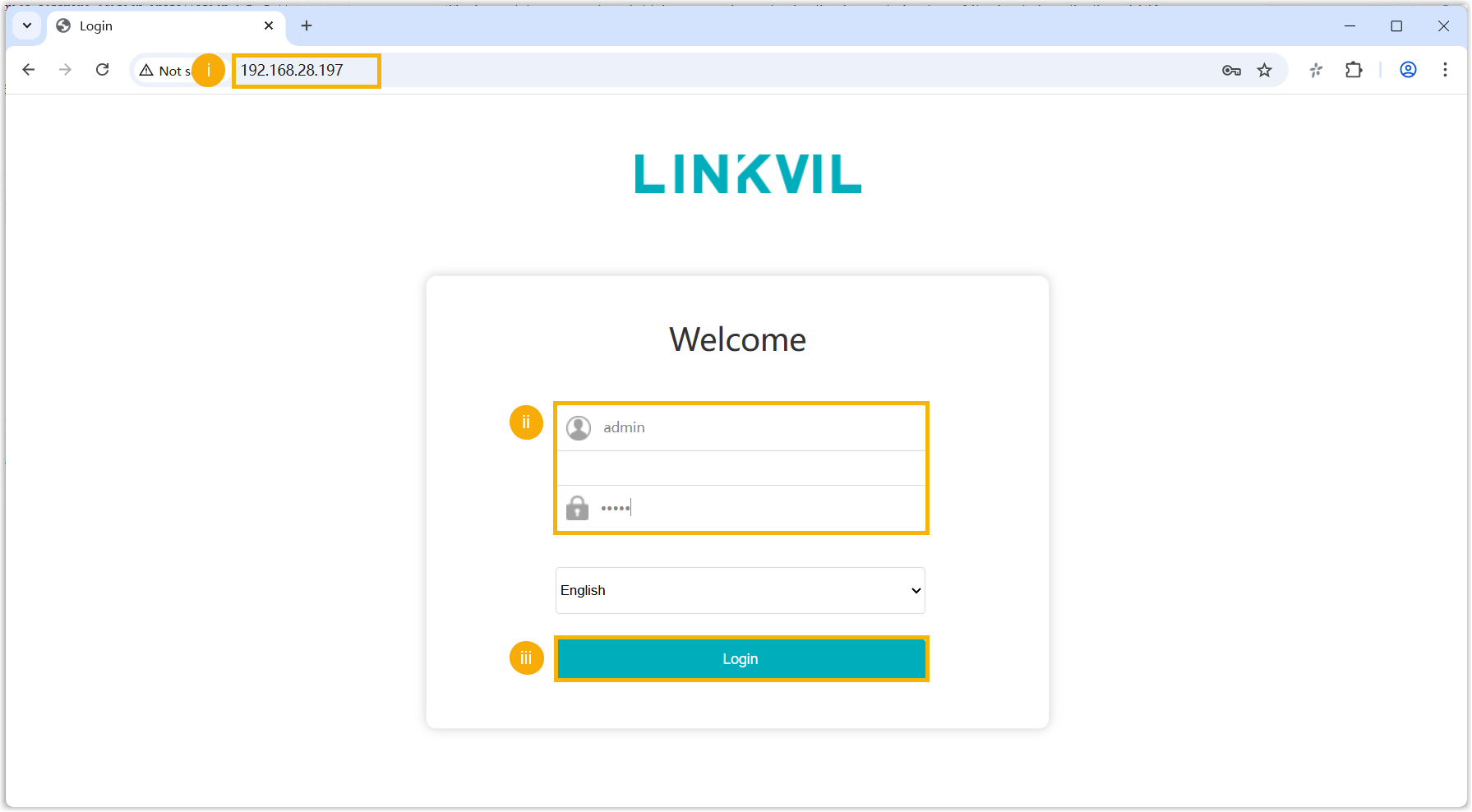
- Optional: Go to , change the default PIN code to enhance the
registration security.Note: In this example, the default PIN code of the W710D base station is
1234.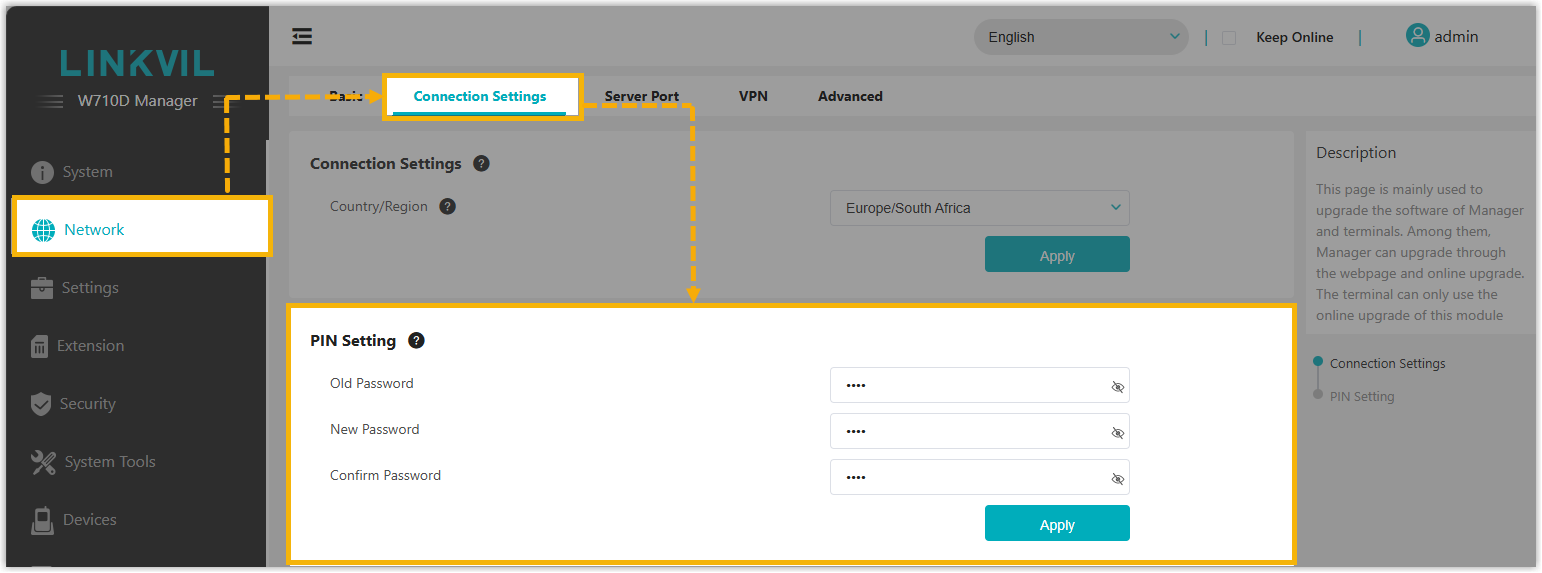
- Go to .
- In the Settings section, turn on the
Auto Authorized and click
Apply.
The registration mode of the DECT base station is enabled.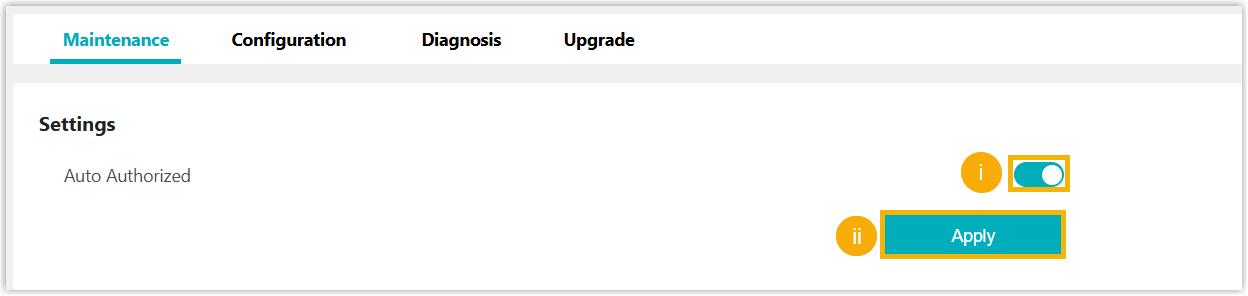
- Access the web interface of the DECT base station using its
IP address.
- On the DECT handset, pair with the DECT base
station.
- Go to .
- Press Scan to
detect the DECT base station.
The RFPI (Radio Fixed Part Identity) of the DECT base station is displayed on the screen.
- Press Link and enter the PIN code of
the DECT base station to complete pairing.
In this example, enter the default PIN code of the W710D base station
1234.When successfully paired, a
 icon appears
next to the base station's RFPI.
icon appears
next to the base station's RFPI.
- On the web interface of the DECT base station, enable the
registration mode of the base station.
- Step 4. Register the Fanvil DECT handset to an extension
- On the DECT base station, register the handset to the desired extension.
-
- On the web interface of the DECT base station, go to .
The paired handset appears in the list.
- Click
 to edit the desired DECT
handset.
to edit the desired DECT
handset.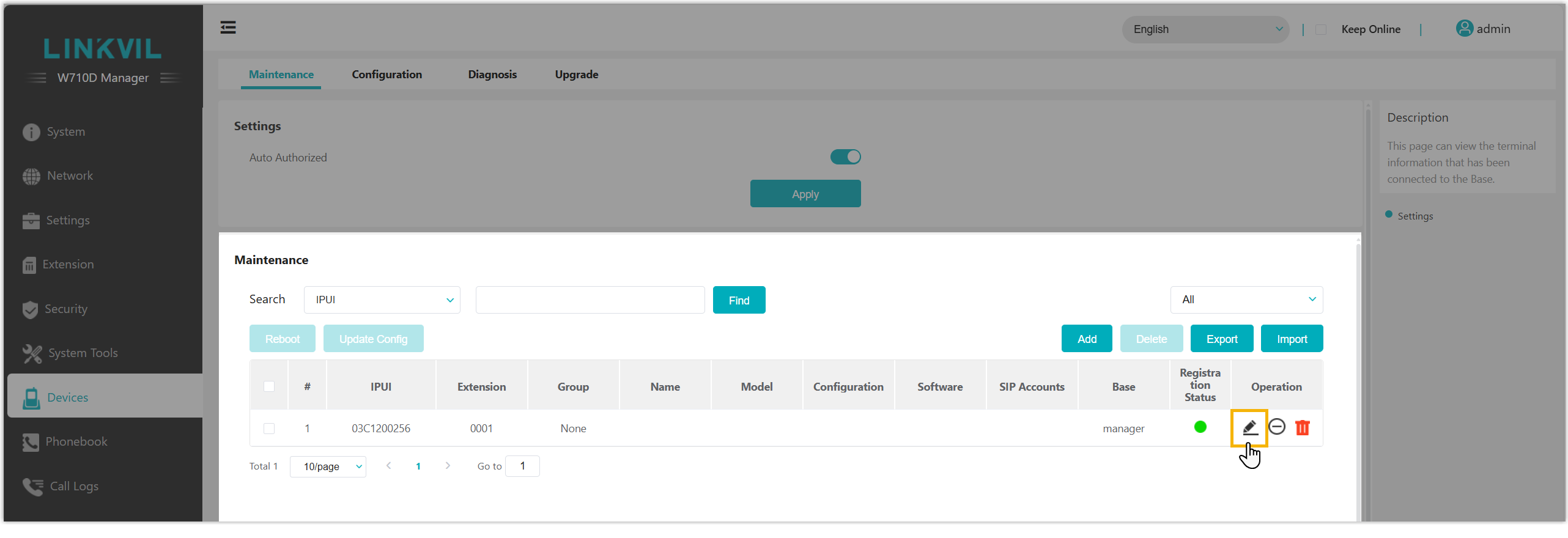
-
In the device details page, click Edit and complete the following settings in the pop-up window.
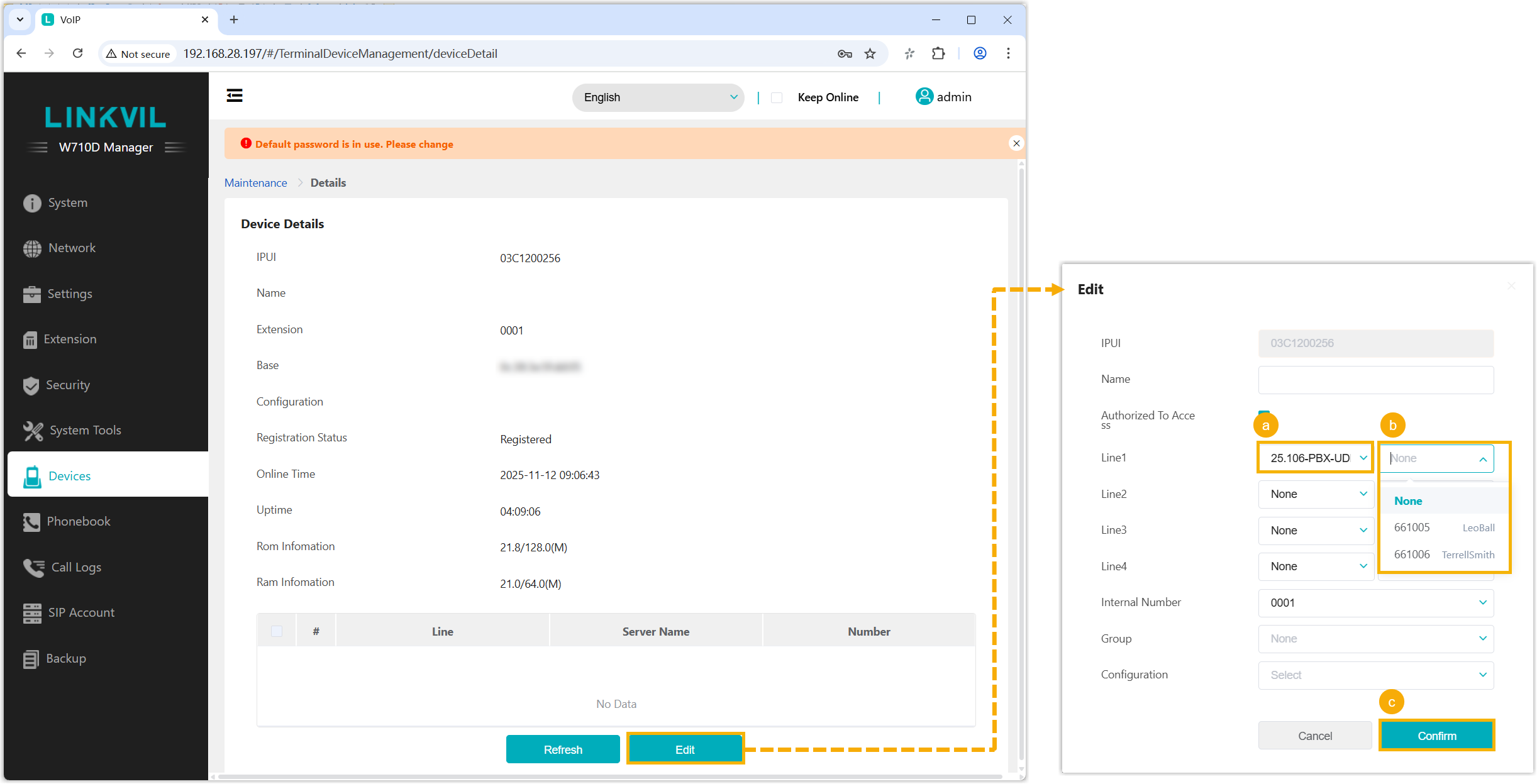
- In the first drop-down list of
Line1, select the transport protocol corresponding to
the desired extension.Note: You can check the extension's transport protocol on PBX web portal (Path: ).
- In the second drop-down list of Line1, select the desired extension.
- Click Confirm.
- In the first drop-down list of
Line1, select the transport protocol corresponding to
the desired extension.
- On the web interface of the DECT base station, go to .
- Result
-
- The handset are successfully registered to the DECT base station,
and associated with the assigned PBX extension via the base
station.
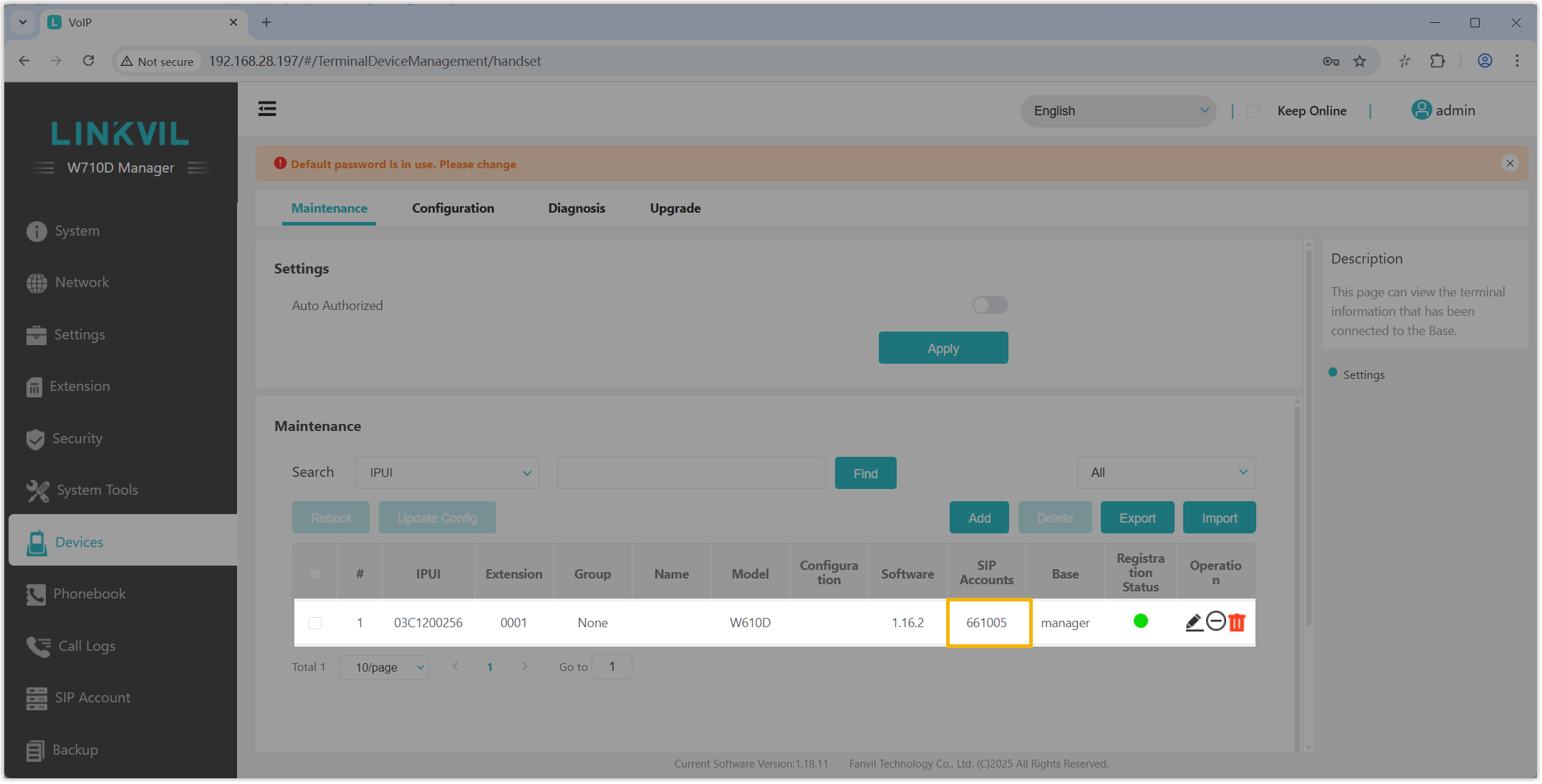
- On the web interface of the DECT
base station, the handset displays its assigned extension
number (Path: ).
- On PBX web portal, you can check
the registration status of the extension on .

- On the DECT handset, the name of the assigned extension is displayed on the home screen.
- On the web interface of the DECT
base station, the handset displays its assigned extension
number (Path: ).
- The registered DECT handset can be used as extensions to make and receive calls.
- The handset are successfully registered to the DECT base station,
and associated with the assigned PBX extension via the base
station.
Auto provision Fanvil DECT system in different subnets (DHCP)
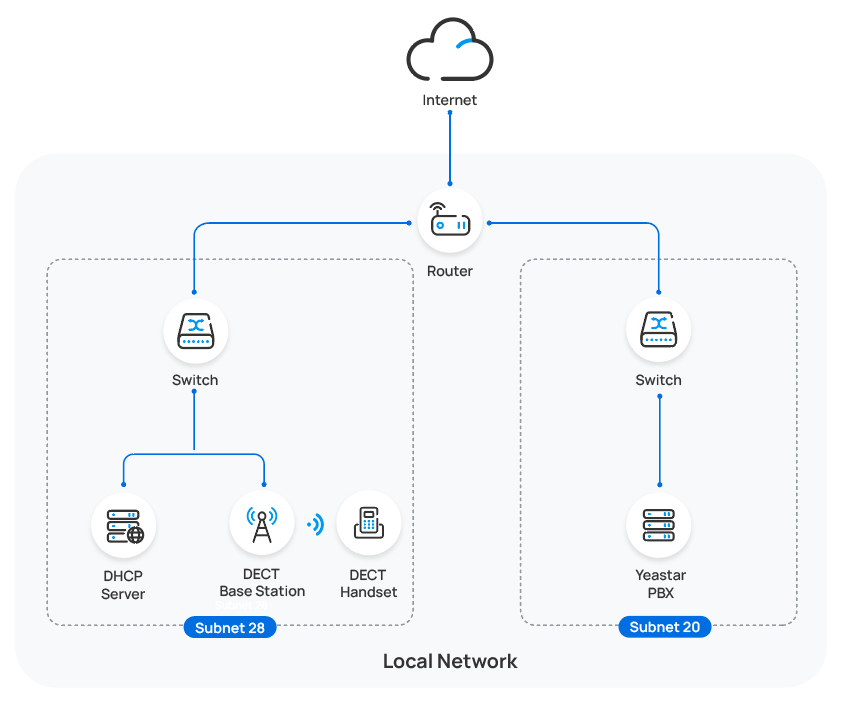
In this example, the DECT system (base station and handset) and a DHCP server are
deployed in subnet (192.168.28.0/24), while the Yeastar PBX (IP:
192.168.20.58) is deployed in subnet
(192.168.20.0/24).
- Prerequisites
-
- Make sure that there is only one DHCP server running in the subnet where the Fanvil DECT system (base station and handset) is deployed, or the base station would fail to obtain an IP address.
- Download and install the Fanvil Device Manager (an IP scanning tool) on your computer that is on the same subnet as the Fanvil DECT system.
- Make sure that the DECT system and PBX can communicate with each other over the subnets.
- Make sure that you have downloaded the template for the desired phone model (Path: ).
- Gather information of the Fanvil DECT base station, including Vendor, Model, and MAC address.
- Procedure
-
- Step 1. Enable Remote Registration feature for extensions on PBX
- Step 2. Add the Fanvil DECT base station on PBX
- Step 3. Configure DHCP option 66 on DHCP server
- Step 4. Obtain the IP address of the Fanvil DECT base station
- Step 5. Pair the Fanvil DECT handset with the DECT base station
- Step 6. Register the Fanvil DECT handset to an extension
- Step 1. Enable Remote Registration feature for extensions on PBX
- On PBX web portal, enable the Remote Registration feature for the extensions
to be assigned to DECT handsets, so that the extensions can be registered in
a different subnet.
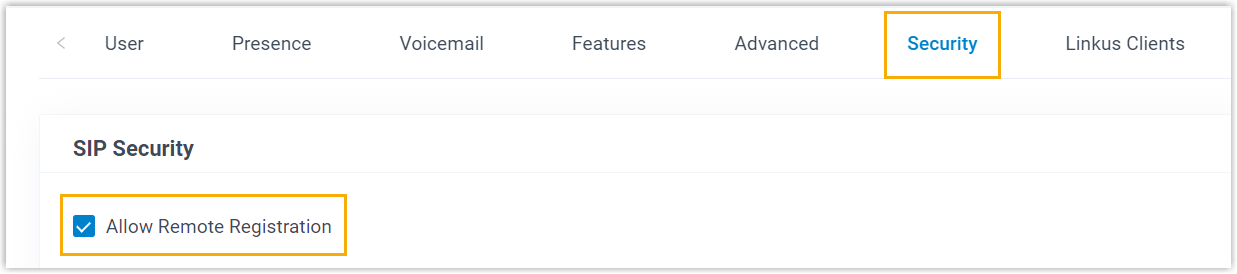
- Log in to PBX web portal, go to , edit the desired extension.
- Click Security tab, select the checkbox of
Allow Remote
Registration
in the SIP Security section.
- Click Save and Apply.
- Step 2. Add the Fanvil DECT base station on PBX
- On PBX web portal, add the DECT base station, complete the provisioning settings, and assign extensions to the DECT handsets.
- On PBX web portal, go to .
- Click .
- In the IP Phone section, enter
the following information.
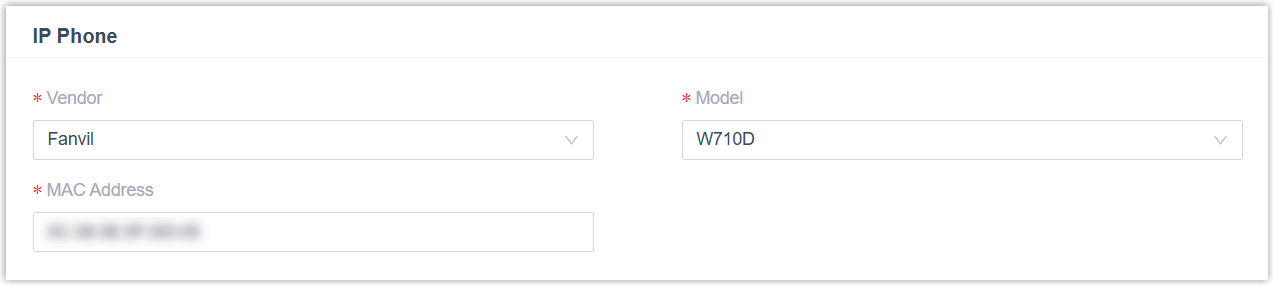
- Vendor: Select Fanvil.
- Model: Select the device model. In this example, select W710D.
- MAC Address: Enter the MAC address of the DECT base station.
- In the Options section, configure the
following settings.

- Template: Select a desired template
from the drop-down list.Note: You can select the default template corresponding to the phone model, or customize your own template. For more information, see Create a Custom Auto Provisioning Template.
- Provisioning Method: Select
DHCP (In the Office).
A provisioning link is automatically generated and displayed in the Provisioning Link field. This provisioning link points to the location where the phone's configuration file is stored.
- Template: Select a desired template
from the drop-down list.
- In the Assign Extension
section, assign extensions for the DECT handsets according to your
needs.
- To assign extensions one by one, do as follows:
- Select the checkbox of the desired handset.
- In the Extension drop-down list, select the desired extension.
- To assign extensions in bulk, do as follows:
- In the Start Extension and End Extension drop-down lists, set the extension range.
- Click Assign
Extension.
Handsets are automatically enabled and assigned with the specified extensions in sequence.
Tip: If your desired extension is not listed in the drop-down list of the Extension column, it indicates that the devices registered to the extension has reached the limit. You can use either of the following methods to proceed.- To release the extension from the associated IP phone or gateway, see Release an Extension from a Provisioned IP Phone/Gateway.
- To raise the phone registration limit, you need to configure the concurrent registration setting for the extension, as the PBX only allows an extension to register with one SIP endpoint by default.
- To assign extensions one by one, do as follows:
- Click Save.The DECT base station is added to the PBX, and displayed in the Auto Provisioning phone list.Tip: You can click in front of the DECT base
station to see the extensions assigned to the DECT
handsets.

- Step 3. Configure DHCP option 66 on DHCP server
- Use the generated provisioning link to configure option 66 on the DHCP server in the subnet where the DECT system is deployed.
-
- On PBX web portal, copy the provisioning link from the device's
detail page.

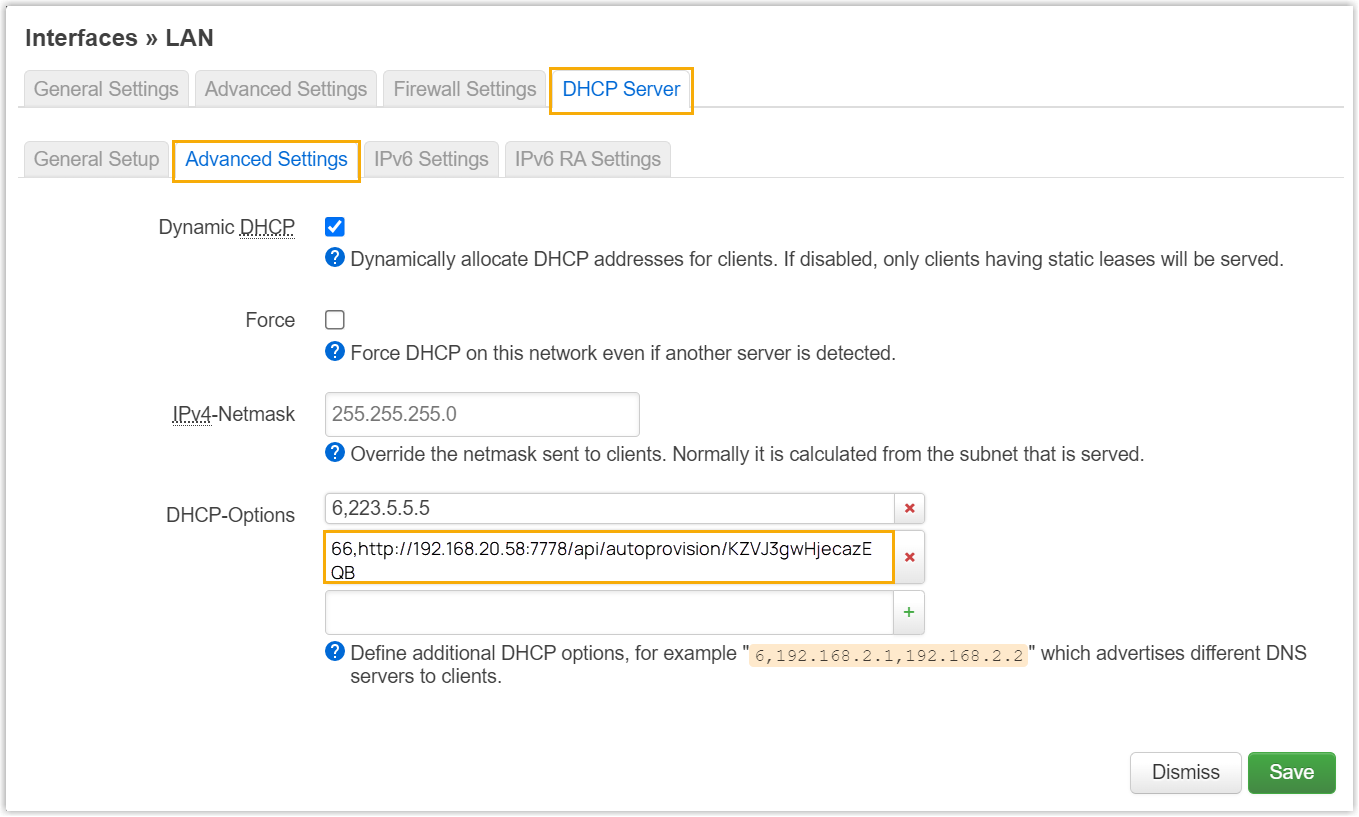
- On the DHCP server, set up option 66 with the
provisioning link.
In this example, the configuration on a router's DHCP server is shown below.
- On PBX web portal, copy the provisioning link from the device's
detail page.
- Step 4. Obtain the IP address of the Fanvil DECT base station
- On the DECT base station, use the device button to reset the
device, so that the base station can obtain an IP address from a DHCP server
in the subnet.
- Press and hold the Reset Key on the DECT base station for at
least 10 seconds until all three LEDs start flashing rapidly, then
release the button.
The DECT base station is reset, and it takes several minutes for the device to boot up. After booted up, the three LEDs are solidly lit, indicating that the DECT base station gets an IP address from the DHCP server and automatically downloads configurations from the PBX.
-
Open the Fanvil Device Manager (an IP scanning tool) and click Rescan.
The DECT base station appears in the Device list along with its IP address.
- Press and hold the Reset Key on the DECT base station for at
least 10 seconds until all three LEDs start flashing rapidly, then
release the button.
- Step 5. Pair the Fanvil DECT handset with the DECT base station
-
Enable the registration mode of the DECT base station, then pair the Fanvil DECT handset with it.
- On the web interface of the DECT base station, enable the
registration mode of the base station.
- Access the web interface of the DECT base station using its
IP address.Note: The default username and password are both
admin. - Optional: Go to , change the default PIN code to enhance the
registration security.Note: In this example, the default PIN code of the W710D base station is
1234. - Go to .
- In the Settings section, turn on the
Auto Authorized and click
Apply.
The registration mode of the DECT base station is enabled.
- Access the web interface of the DECT base station using its
IP address.
- On the DECT handset, pair with the DECT base
station.
- Go to .
- Press Scan to
detect the DECT base station.
The RFPI (Radio Fixed Part Identity) of the DECT base station is displayed on the screen.
- Press Link and enter the PIN code of
the DECT base station to complete pairing.
In this example, enter the default PIN code of the W710D base station
1234.When successfully paired, a
icon appears
next to the base station's RFPI.
- On the web interface of the DECT base station, enable the
registration mode of the base station.
- Step 6. Register the Fanvil DECT handset to an extension
- On the DECT base station, register the handset to the desired extension.
-
- On the web interface of the DECT base station, go to .
The paired handset appears in the list.
- Click to edit the desired DECT
handset.
-
In the device details page, click Edit and complete the following settings in the pop-up window.
- In the first drop-down list of
Line1, select the transport protocol corresponding to
the desired extension.Note: You can check the extension's transport protocol on PBX web portal (Path: ).
- In the second drop-down list of Line1, select the desired extension.
- Click Confirm.
- In the first drop-down list of
Line1, select the transport protocol corresponding to
the desired extension.
- On the web interface of the DECT base station, go to .
- Result
-
- The handset are successfully registered to the DECT base station,
and associated with the assigned PBX extension via the base
station.
- On the web interface of the DECT
base station, the handset displays its assigned extension
number (Path: ).
- On PBX web portal, you can check the registration status of
the extension on .

- On the DECT handset, the name of the assigned extension is displayed on the home screen.
- On the web interface of the DECT
base station, the handset displays its assigned extension
number (Path: ).
- The registered DECT handset can be used as extensions to make and receive calls.
- The handset are successfully registered to the DECT base station,
and associated with the assigned PBX extension via the base
station.
Auto provision Fanvil DECT system in remote network (RPS)
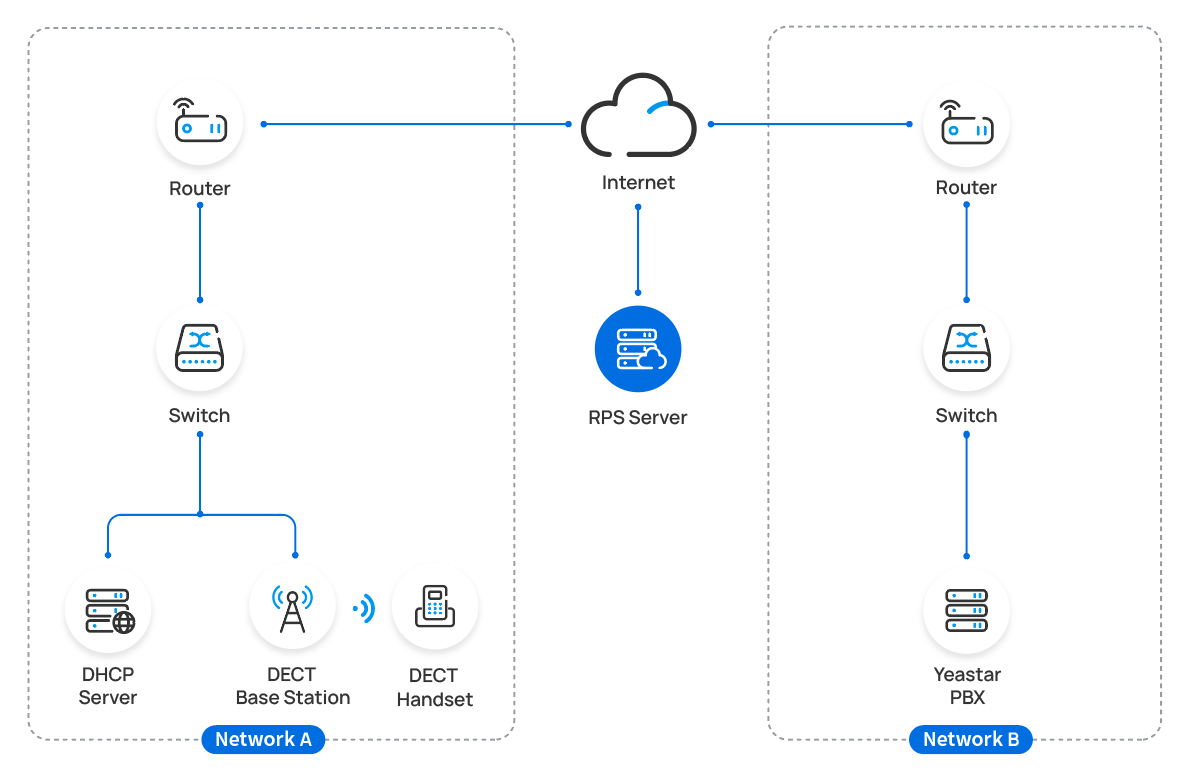
In this example, the Fanvil DECT system (base station and handset) and a DHCP server are deployed in Network A, and the Yeastar PBX is deployed in Network B.
- Prerequisites
- Yeastar P-Series PBX System supports to auto provision Fanvil DECT system remotely either using Yeastar FQDN or using public IP address / external host / Yeastar domain name. According to the provisioning method you intend to use, make sure that you have completed the corresponding setup shown below.
-
Method Setting Using Yeastar FQDN -
Subscribe to Enterprise Plan or Ultimate Plan for the PBX and ensure the FQDN is available.
- Grant remote access permission for the extension
to be registered and the DECT base station:
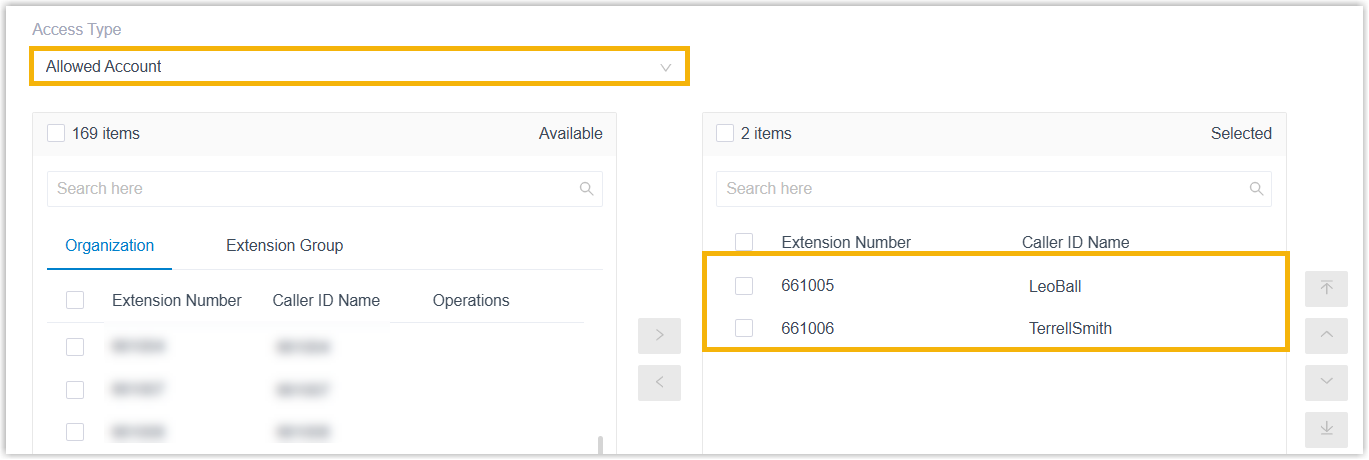
- Grant remote SIP access permission for the
extension, so that the extension can be
registered remotely via FQDN (Path: ).
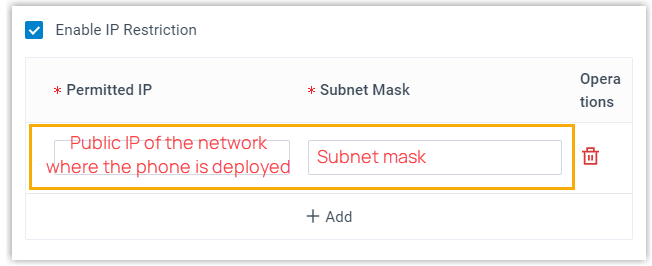
- If you have enabled IP restriction for Yeastar FQDN remote
Web access, make sure that you have added
the phone's IP address to the permitted IP list,
so that the phone can obtain configuration files
from the PBX (Path: ).
- Grant remote SIP access permission for the
extension, so that the extension can be
registered remotely via FQDN (Path: ).
- Make sure that there is only one DHCP server running in the subnet where the Fanvil DECT system (base station and handset) is deployed, or the base station would fail to obtain an IP address.
- Download and install the Fanvil Device Manager (an IP scanning tool) on your computer that is on the same subnet as the Fanvil DECT system.
- Make sure that you have downloaded the template for the desired phone model (Path: ).
- Gather information of the Fanvil DECT base station, including Vendor, Model, and MAC address.
Using public IP address / external host / Yeastar domain name - Configure PBX network for remote access
by a public IP address, by an external host domain name, or by a Yeastar domain name.Important: The following PBX ports MUST be forwarded for RPS provisioning.
- RTP ports
- SIP port
- Web Server port
- Set up the extension for remote
registration.
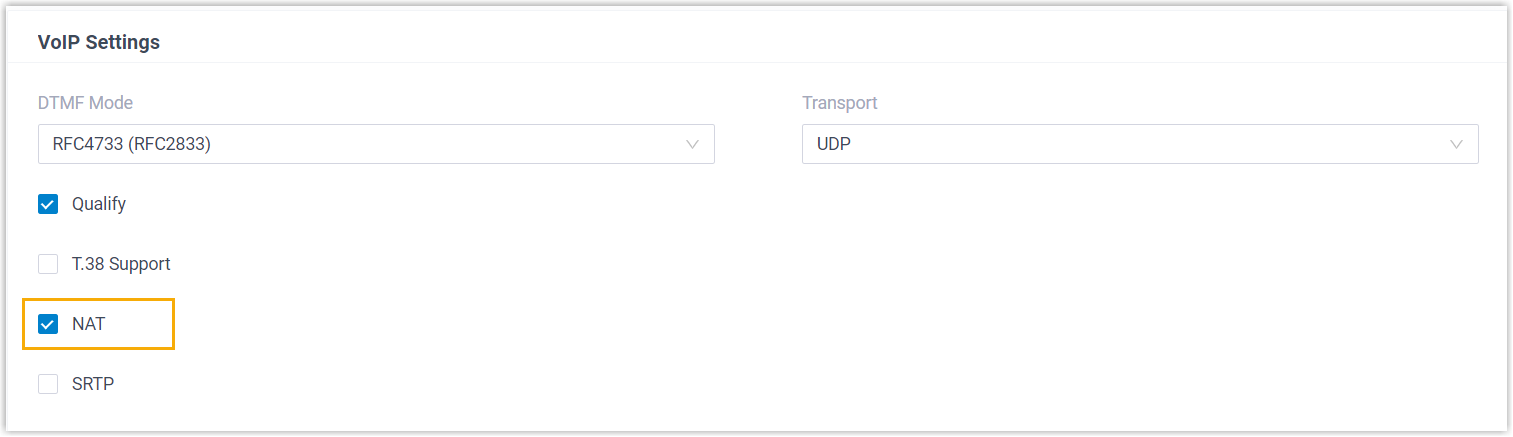
- Enable
NAT
for the extension (Path: Extension and Trunk > Extension > > Advanced > VoIP Settings > NAT).
- Enable Remote Registration feature for the extension
(Path: Extension and Trunk > Extension > > Security > SIP Security > Allow Remote Registration).
- Enable
NAT
for the extension (Path: Extension and Trunk > Extension >
- Make sure that there is only one DHCP server running in the subnet where the Fanvil DECT system (base station and handset) is deployed, or the base station would fail to obtain an IP address.
- Download and install the Fanvil Device Manager (an IP scanning tool) on your computer that is on the same subnet as the Fanvil DECT system.
- Make sure that you have downloaded the template for the desired phone model (Path: ).
- Gather information of the Fanvil DECT base station, including Vendor, Model, and MAC address.
-
- Procedure
- Step 1. Add the Fanvil DECT base station on PBX
- On PBX web portal, add the DECT base station, complete the provisioning settings, and assign extensions to the DECT handsets.
- On PBX web portal, go to .
- Click .
- In the IP Phone section, enter
the following information.
- Vendor: Select Fanvil.
- Model: Select the device model. In this example, select W710D.
- MAC Address: Enter the MAC address of the DECT base station.
- In the Options section, configure the
following settings.
Figure 1. RPS using Yeastar FQDN 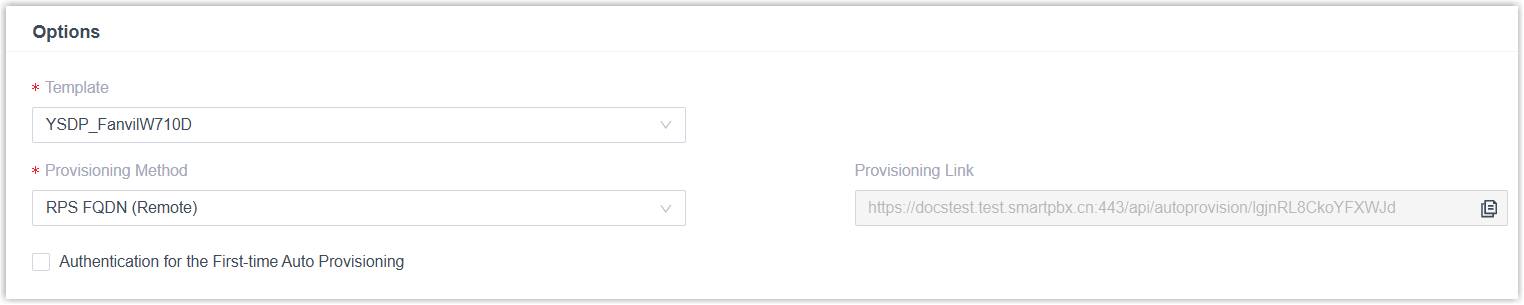
Figure 2. RPS using public IP address / external host / Yeastar domain 
- Template: Select a
desired template from the drop-down list.Note: You can select the default template corresponding to the phone model, or customize your own template. For more information, see Create a Custom Auto Provisioning Template.
- Provisioning Method:
Select RPS FQDN (Remote) or
RPS (Remote) according to your
need.
A provisioning link is automatically generated and displayed in the Provisioning Link field. This provisioning link points to the location where the phone's configuration file is stored.
- Authentication for the First-time Auto
Provisioning: Unselect the
checkbox.Note: To successfully connect the DECT base station to the Yeastar PBX, it is necessary to disable this option.
- Template: Select a
desired template from the drop-down list.
- In the Assign Extension
section, assign extensions for the DECT handsets according to your
needs.
- To assign extensions one by one, do as follows:
- Select the checkbox of the desired handset.
- In the Extension drop-down list, select the desired extension.
- To assign extensions in bulk, do as follows:
- In the Start Extension and End Extension drop-down lists, set the extension range.
- Click Assign
Extension.
Handsets are automatically enabled and assigned with the specified extensions in sequence.
Tip: If your desired extension is not listed in the drop-down list of the Extension column, it indicates that the devices registered to the extension has reached the limit. You can use either of the following methods to proceed.- To release the extension from the associated IP phone or gateway, see Release an Extension from a Provisioned IP Phone/Gateway.
- To raise the phone registration limit, you need to configure the concurrent registration setting for the extension, as the PBX only allows an extension to register with one SIP endpoint by default.
- To assign extensions one by one, do as follows:
- Click Save.
The DECT base station is added to the PBX, and displayed in the Auto Provisioning phone list; The PBX will send an event notification of RPS Request Success.
Tip: You can click in front of the DECT base
station to see the extensions assigned to the DECT
handsets.
- Step 2. Obtain the IP address of the Fanvil DECT base station
- On the DECT base station, use the device button to reset the
device, so that the base station can obtain an IP address from a DHCP server
in the subnet.
- Press and hold the Reset Key on the DECT base station for at
least 10 seconds until all three LEDs start flashing rapidly, then
release the button.
The DECT base station is reset, and it takes several minutes for the device to boot up. After booted up, the three LEDs are solidly lit, indicating that the DECT base station gets an IP address from the DHCP server and automatically downloads configurations from the PBX.
-
Open the Fanvil Device Manager (an IP scanning tool) and click Rescan.
The DECT base station appears in the Device list along with its IP address.
- Press and hold the Reset Key on the DECT base station for at
least 10 seconds until all three LEDs start flashing rapidly, then
release the button.
- Step 3. Pair the Fanvil DECT handset with the DECT base station
-
Enable the registration mode of the DECT base station, then pair the Fanvil DECT handset with it.
-
- On the web interface of the DECT base station, enable the
registration mode of the base station.
- Access the web interface of the DECT base station using its
IP address.Note: The default username and password are both
admin. - Optional: Go to , change the default PIN code to enhance the
registration security.Note: In this example, the default PIN code of the W710D base station is
1234. - Go to .
- In the Settings section, turn on the
Auto Authorized and click
Apply.
The registration mode of the DECT base station is enabled.
- Access the web interface of the DECT base station using its
IP address.
- On the DECT handset, pair with the DECT base
station.
- Go to .
- Press Scan to
detect the DECT base station.
The RFPI (Radio Fixed Part Identity) of the DECT base station is displayed on the screen.
- Press Link and enter the PIN code of
the DECT base station to complete pairing.
In this example, enter the default PIN code of the W710D base station
1234.When successfully paired, a
icon appears
next to the base station's RFPI.
- On the web interface of the DECT base station, enable the
registration mode of the base station.
- Step 4. Register the Fanvil DECT handset to an extension
- On the DECT base station, register the handset to the desired extension.
-
- On the web interface of the DECT base station, go to .
The paired handset appears in the list.
- Click to edit the desired DECT
handset.
-
In the device details page, click Edit and complete the following settings in the pop-up window.
- In the first drop-down list of
Line1, select the transport protocol corresponding to
the desired extension.Note: You can check the extension's transport protocol on PBX web portal (Path: ).
- In the second drop-down list of Line1, select the desired extension.
- Click Confirm.
- In the first drop-down list of
Line1, select the transport protocol corresponding to
the desired extension.
- On the web interface of the DECT base station, go to .
- Result
-
- The handset are successfully registered to the DECT base station,
and associated with the assigned PBX extension via the base
station.
- On the web interface of the DECT
base station, the handset displays its assigned extension
number (Path: ).
- On PBX web portal, you can check the registration status of
the extension on .

- On the DECT handset, the name of the assigned extension is displayed on the home screen.
- On the web interface of the DECT
base station, the handset displays its assigned extension
number (Path: ).
- The registered DECT handset can be used as extensions to make and receive calls.
- The handset are successfully registered to the DECT base station,
and associated with the assigned PBX extension via the base
station.