Configure AI Call Transcription with OpenAI Service
Yeastar P-Series Cloud Edition supports AI call transcription powered by OpenAI Speech to Text service, transcribing the audio of a two-party call into readable text in real time. This topic describes how to configure AI call transcription with the third-party service on the PBX.
Requirements
Yeastar P-Series Cloud Edition should meet the following requirements:
| Item | Requirement |
|---|---|
| Firmware | 84.24.0.30 or later. |
| Subscription |
The AI Transcription feature includes one-time free minutes with your plan subscription (120 minutes for Enterprise Plan or 240 minutes for Ultimate Plan). To expand AI transcription minutes, contact your service provider to subscribe to the following add-on service(s) (Path: ). 
Note: If both services are subscribed,
minutes are deducted from the monthly quota pack
first. |
Prerequisites
- PBX network access
-
Make sure the Yeastar P-Series Cloud Edition can access the following domains to use corresponding services:Note:
You can verify domain accessibility on the PBX (Path: ).
Service Domain OpenAI Speech to Text service api.openai.comGPT/Gemini LLM According to your preferred LLM, the PBX must be able to access the following corresponding domains:
- GPT LLM:
api.openai.com - Gemini LLM:
oauth2.googleapis.comandgenerativelanguage.googleapis.com
- GPT LLM:
- Third-party service account
-
You have prepared third-party service accounts and login credentials as follows:
Service Account OpenAI Speech to Text service Prepare an OpenAI account with sufficient transcription minute quotas for OpenAI Speech to Text service, and obtain the username and password. GPT/Gemini LLM According to your preferred LLM, the account must meet the following requirements: - GPT LLM: Make sure the OpenAI account have sufficient token quota.
- Gemini LLM: Prepare a Google account with sufficient token quota, and obtain the username and password.
Procedure
Step 1. Create an API key for OpenAI Speech to Text service
To securely access the OpenAI Speech to Text service from the PBX, you must create an API key on OpenAI Platform first for the service API request authentication.
- Log in to OpenAI Platform using your OpenAI username and password, go to API Keys.
- At the top-right corner of the API key list, click Create new secret key.
- In the pop-up window, create a new API key.
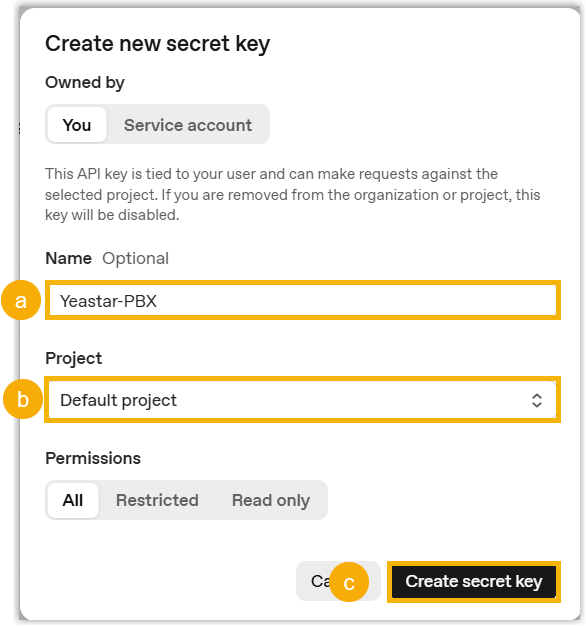
- In the Name field, enter a name to identify the API key.
- In the Project drop-down list, select the desired project.
- Keep the default All permission, and click Create
secret key.
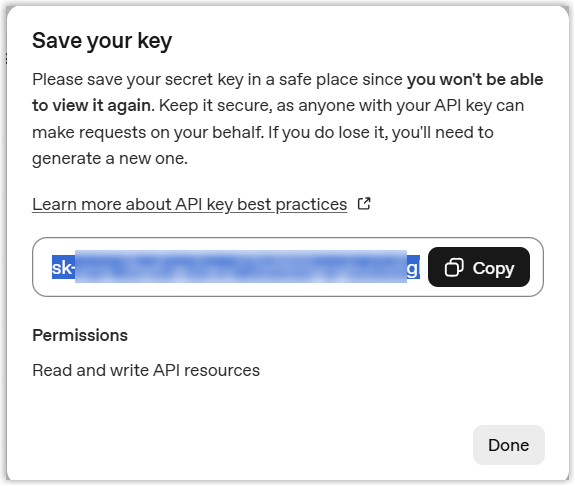
A pop-up window appears, displaying the generated API key.
-
In the pop-up window, click Copy to copy the API key and save it for later use.
Step 2. (Optional) Create an API key for Gemini LLM
Yeastar P-Series Cloud Edition allows you to invoke Gemini LLM (provided by Google) to automatically generate call summaries from transcribed text after calls end. To implement this feature, you need to create an API key using Google account to authenticate requests.
- Log in to Google AI Studio using your Google username and password, go to .
- At the top-right corner of the API key list, click Create API key.
- In the pop-up window, create a new API key.
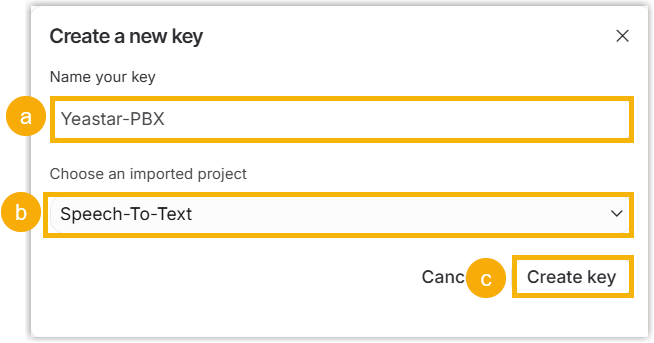
- In the Name your key field, enter a name to identify the API key.
- In the Choose an imported project
drop-down list, select a desired project.Note: In the drop-down list, you can select an existing project, import a project, or create a new one as needed.
- Click Create key.
A pop-up window appears, displaying the details of the generated API key.
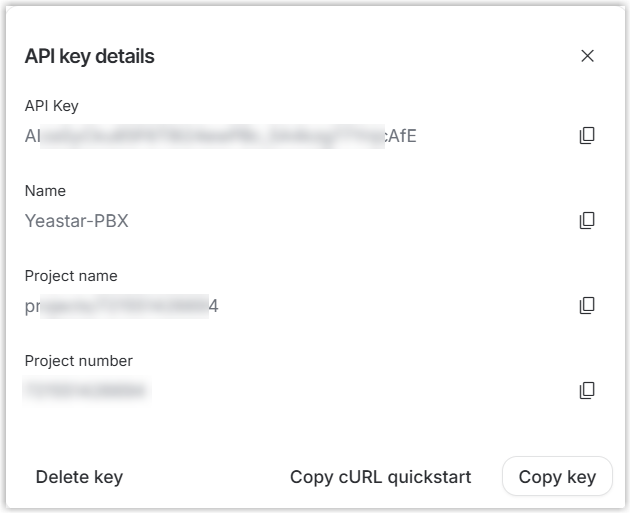
- In the pop-up window, click Copy key to copy the API key and save it for later use.
Step 3. Configure AI call transcription on the Yeastar PBX
After you create authentication credentials for OpenAI Speech to Text service and LLM, you need to configure corresponding settings on the PBX to establish connections between the PBX and the two services.
- Log in to PBX web portal, go to .
- Turn on the switch of Call Transcription.
- Configure AI call transcription
service.
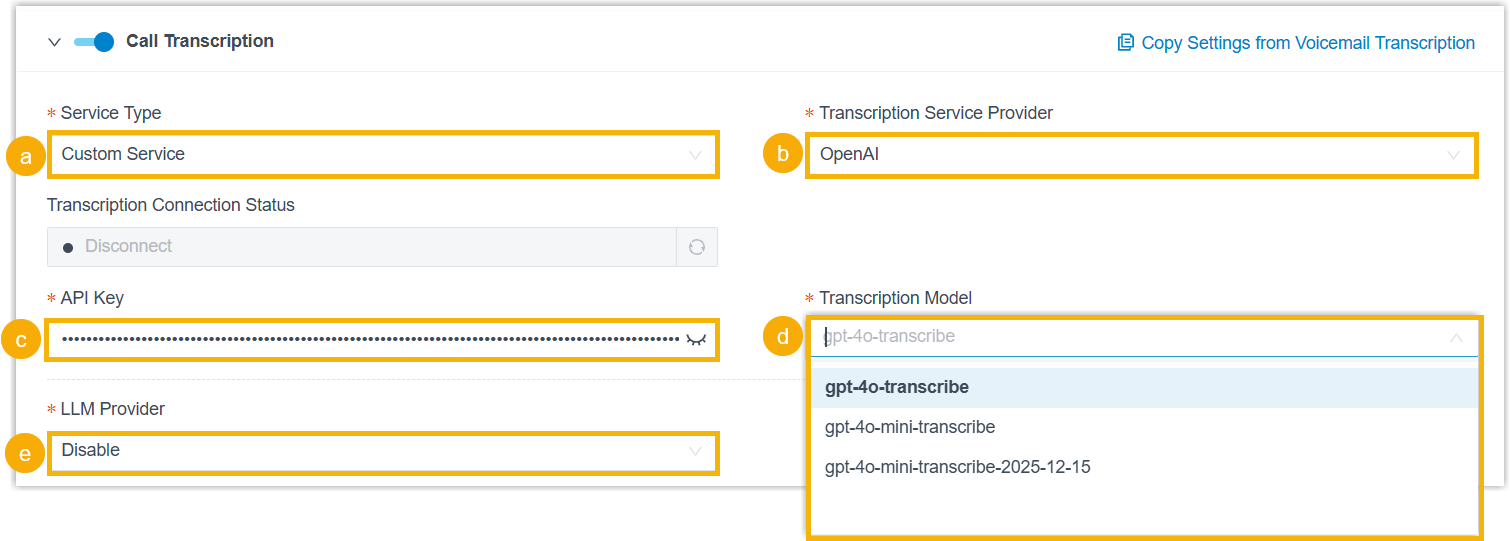
- In the Service Type drop-down list, select Custom Service.
- In the Transcription Service Provider drop-down list, select OpenAI.
- In the API key field, paste the API key created on OpenAI platform.
- In the Transcription Model drop-down list, select your preferred transcription model supported by OpenAI Speech to Text service. For details on the differences between the transcription models, see the list of OpenAI Realtime & audio models.
-
Configure the LLM service.
Option Instruction Disable If you do not need the PBX to generate call summaries, select Disable in the LLM Provider drop-down list. OpenAI To use GPT LLM, complete the following settings:
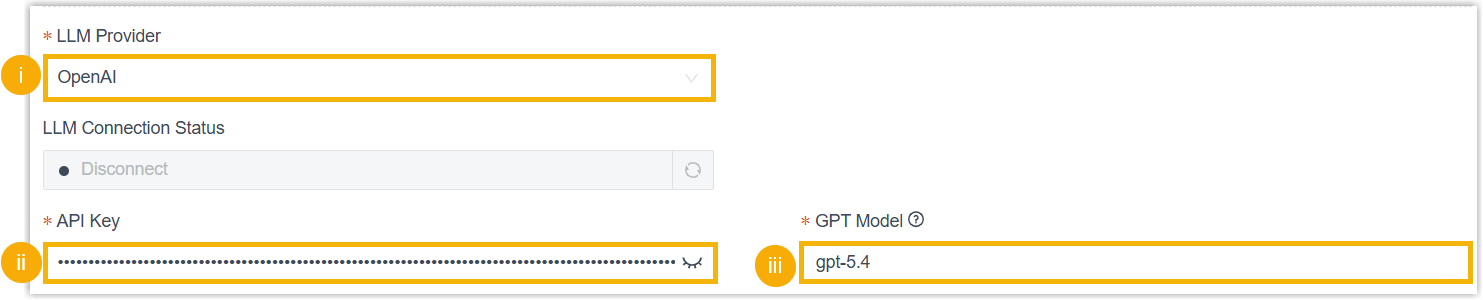
- In the LLM Provider drop-down list, select OpenAI.
- In the API key field, paste the API key created on OpenAI Platform.
- In the GPT
Model field, enter the model ID of
your preferred GPT LLM.Note: You can access the list of GPT Models to check the model ID of your desired GPT LLM. For example, if you want to use GPT-5.4, enter the model ID
gpt-5.4in this field.
Google To use Gemini LLM, complete the following settings:

- In the LLM Provider drop-down list, select Google.
- In the API key field, paste the API key created on Google AI Studio.
- In the
Gemini Model field, enter
the model code of your preferred Gemini LLM.Note: You can access the list of Gemini Models and go to introduction page of your desired Gemini LLM to check its model code. For example, if you want to use Gemini 3.1 Pro Preview, enter the model code
gemini-3.1-pro-previewin this field.
-
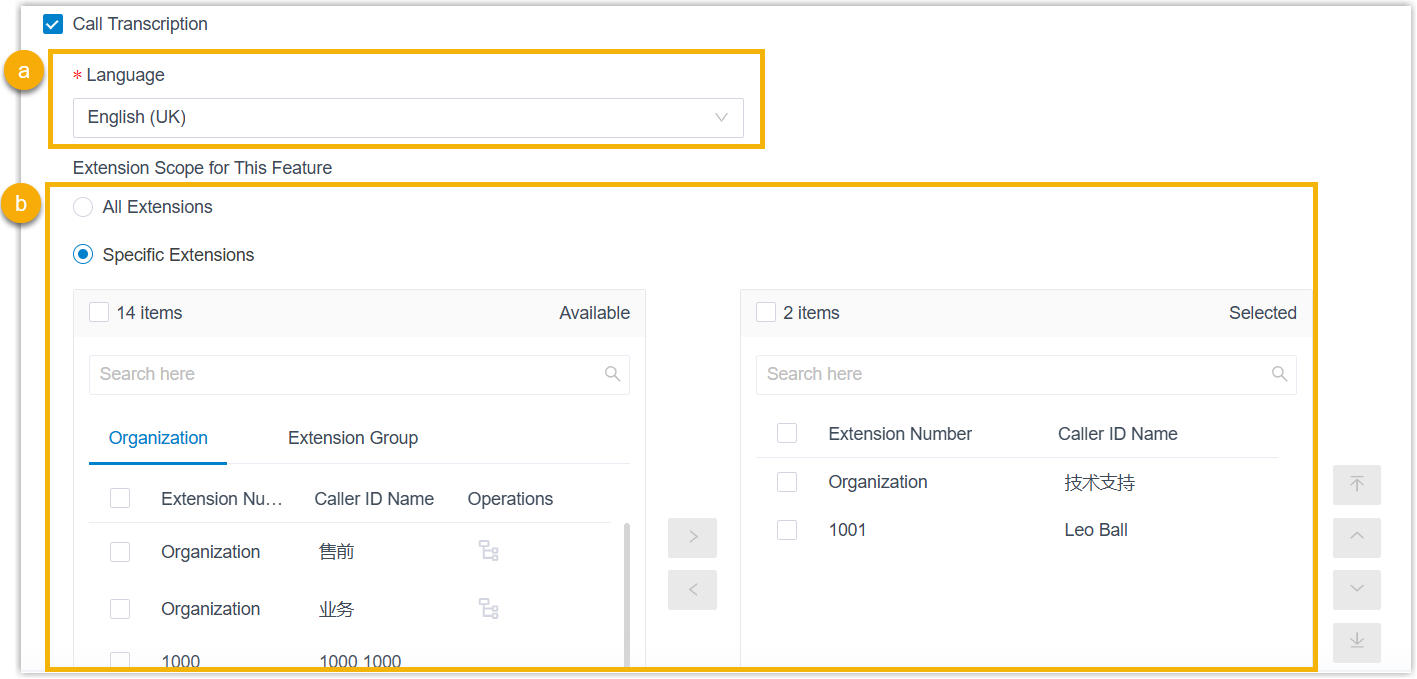
In the Language drop-down list, select the desired language to be detected and transcribed for call audio.
- In the Extension
Scope for This Feature section, specify which extensions /
extension groups / departments have access to the call transcription
feature.
- All Extensions: All extensions can use this feature.
- Specific Extensions: Only selected extensions can use this feature.
- Optional: In the
Automatic Call Transcription section, configure which
call types will be automatically transcribed for the extensions that are allowed to use call transcription.Note: This setting takes precedence over the extension-level Automatic Call Transcription configuration (either the setting that you configured for individual extensions or those set by extension users in their Linkus UC Clients).
Call Type Description Internal If selected, all internal calls involving the authorized extensions will be automatically transcribed. Outbound If selected, all outbound calls from the authorized extensions will be automatically transcribed. Inbound If selected, you need to further configure automatic call transcription based on the inbound call scenarios. 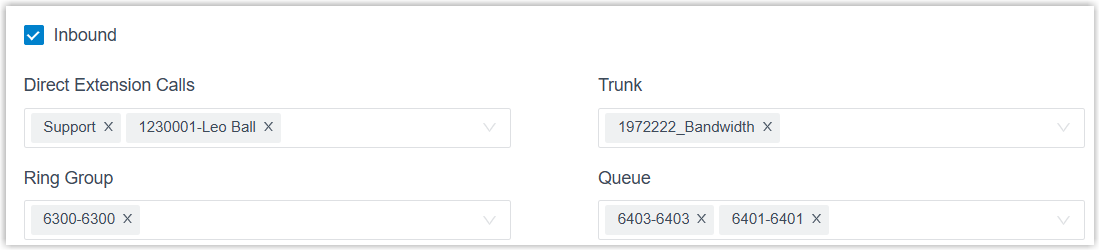
- To automatically transcribe calls that are directly routed to specified extensions, select the desired extensions / extension groups / departments in the Direct Extension Calls drop-down list.
- To automatically transcribe calls routed through specified trunks to any authorized extension, select the desired trunks in the Trunk drop-down list.
- To automatically transcribe calls that are routed to specified ring groups and answered by the authorized extensions, select the desired ring groups in the Ring Group drop-down list.
- To automatically transcribe calls that are routed to specified queues and answered by the authorized extensions, select the desired queues in the Queue drop-down list.
- Click Save.
Result
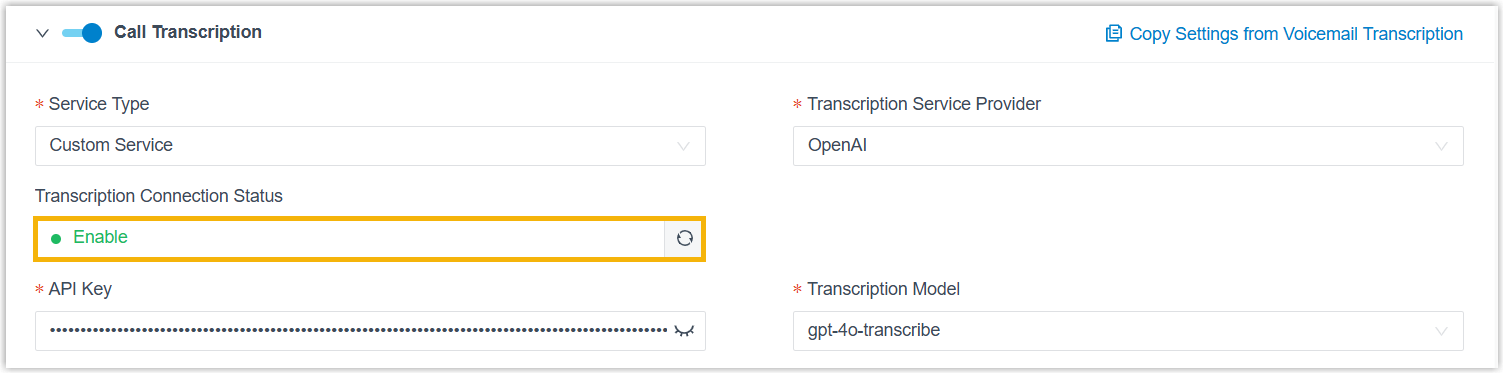
- The Transcription Connection Status displays Enable, indicating
that the AI call transcription feature powered by OpenAI Speech to Text service
is enabled. Call audio can be detected and transcribed into readable text in the
specified language in real time via the OpenAI service.
 Note: You can configure the call transcription language and mode (either automatic or manual) for extensions individually as needed (Path: Extension and Trunk > Extension >
 > AI > Call Transcription). For more information, see Configure AI Call Transcription for an Extension.
 -
The LLM Connection Status displays Enable, indicating that the PBX is successfully connected to the configured LLM. The PBX will automatically generate call summaries from transcribed text after calls end via the LLM.
