Basic Deployment Architecture
This topic describes the basic deployment architecture of NovoOne, helping you grasp the distribution of server nodes and clarify the communication relationships between system components, laying the groundwork for subsequent deployment and use.
Architecture
NovoOne adopts a cloud-native deployment architecture based on Kubernetes. This leverages container orchestration to support elastic workload scheduling, self-healing, and centralized resource management, supporting the stability and scalability of the overall call service.
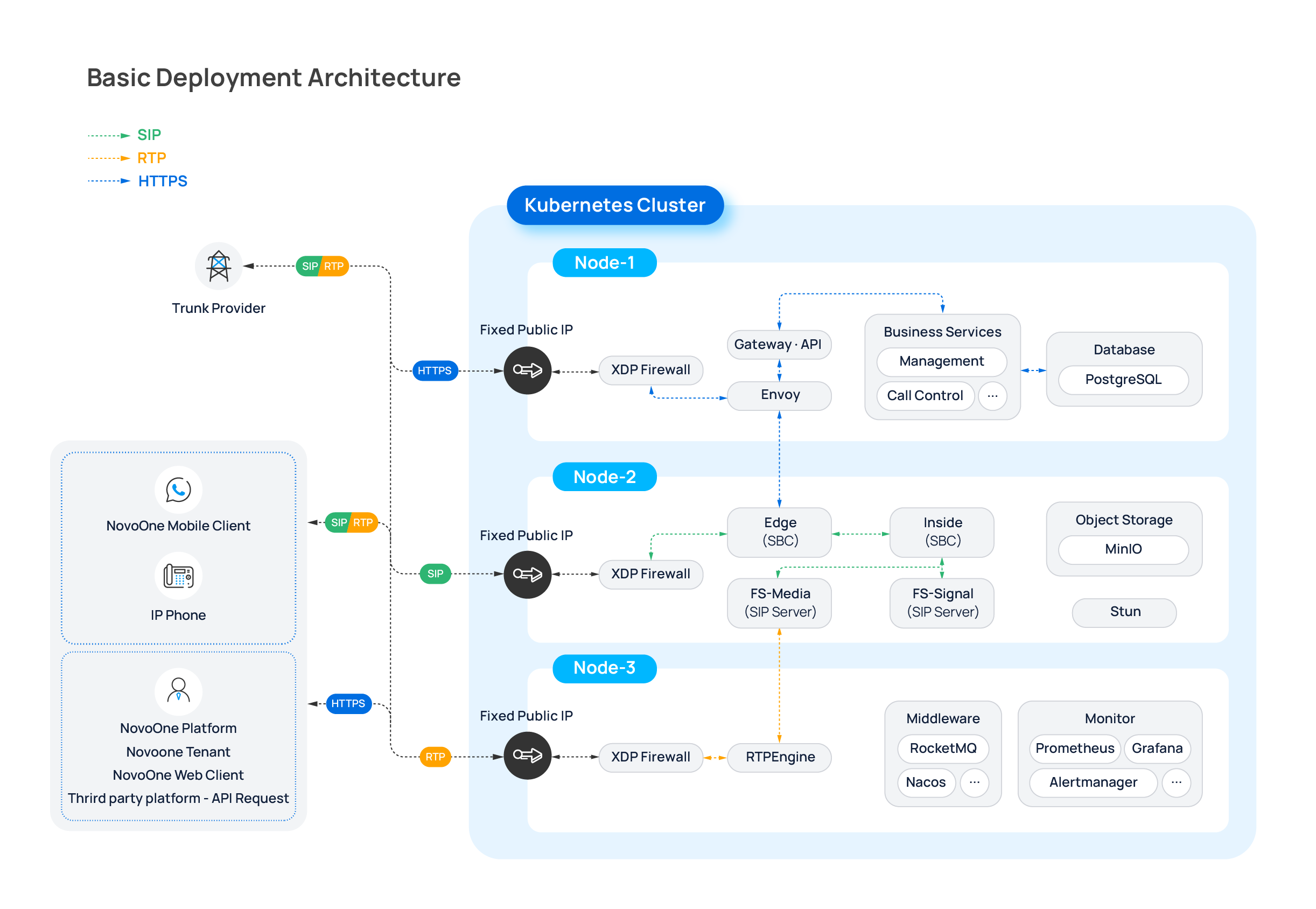
The figure below shows the most basic architecture of NovoOne.
- Traffic source
-
- Trunk Provider (ITSP): ITSP sends SIP signaling traffic and RTP media traffic for inbound and outbound PSTN calls.
- SIP Endpoints: SIP endpoints include NovoOne Mobile Client and IP Phone. The endpoints send SIP signaling traffic and RTP media traffic for endpoint registration and call-related operations.
- HTTPS Clients: HTTPS clients include NovoOne Platform, NovoOne Tenant, NovoOne Web Client, and Third-party platform integrated with NovoOne API. These clients send HTTPS traffic for web access, management operations, and API-based interactions.
- Traffic routing
-
Traffic from external sources is routed to the Kubernetes Cluster, where it is processed by the corresponding components.
In this deployment, the cluster consists of three network-connected nodes, with each node assigned a dedicated fixed public IP address. Components run as Pods (the smallest deployable unit in Kubernetes) on these nodes, with one running Pod for each component type.
The cluster can schedule Pods to any node to meet the applicable scheduling requirements and enable traffic transmission between components hosted on different nodes.